The increasing demand for faster data transmission, higher network capacity, and improved energy efficiency is driving innovation across the optical communication industry. As cloud computing, artificial intelligence, and advanced digital services continue expanding, communication systems require optical components that can handle higher speeds while maintaining reliable performance.
Optical modulators are becoming increasingly important in this transformation because they control how information is carried through optical signals.
At Liobate, we develop advanced thin-film lithium niobate (TFLN) devices designed to improve optical modulation performance. Our high-performance fiber optic modulators are built on proprietary thin-film lithium niobate technology and deliver ultra-high bandwidth, low drive voltage, and low insertion loss. These solutions support a wide range of optical communication, testing, and photonic applications.
Understanding TFLN Devices and Thin-Film Lithium Niobate Technology
TFLN devices are photonic components based on thin-film lithium niobate materials. Lithium niobate has long been recognized as an excellent material for optical applications because of its strong electro-optic properties, wide optical transparency range, and fast response characteristics. By applying thin-film technology, engineers can achieve stronger optical confinement and improved device integration.
Compared with traditional lithium niobate devices, TFLN devices provide advantages in size, efficiency, and high-frequency performance. These characteristics make them suitable for next-generation optical systems that require faster signal processing and lower energy consumption.
At Liobate, we use thin-film lithium niobate technology to develop advanced optical modulators that meet the requirements of modern communication and measurement systems. Our products are designed to help customers achieve high-speed optical signal control with improved system efficiency.
The Role of Optical Modulators in Modern Communication Systems
Optical modulators are essential components in optical communication because they convert electrical signals into controlled optical signals. By adjusting the properties of light, such as intensity or phase, optical modulators enable data to be transmitted through fiber networks.
As communication speeds continue increasing, optical modulators must provide higher bandwidth and better signal quality. Traditional modulation technologies may face challenges when supporting advanced applications such as high-speed optical transceivers, coherent communication systems, and precision test instruments.
TFLN devices offer an effective solution by combining high-speed electro-optic performance with low optical loss. Through advanced modulation capabilities, they help optical systems achieve faster transmission rates while maintaining signal integrity.
How TFLN Devices Improve Optical Modulation Performance
The performance of optical modulators depends on several key factors, including bandwidth, insertion loss, and drive voltage. These characteristics directly influence the efficiency and reliability of optical communication systems.
One of the major advantages of TFLN devices is their ultra-high bandwidth capability. High bandwidth allows optical modulators to process faster electrical signals, making them suitable for demanding applications where large volumes of data must be transmitted quickly.
Low drive voltage is another important benefit. A lower operating voltage reduces the power required for modulation, helping improve the energy efficiency of optical systems. This is especially valuable for large-scale data centers and communication networks where power consumption is a major consideration.
Low insertion loss also contributes to better optical performance. By minimizing signal attenuation, TFLN-based optical modulators help maintain stronger optical signals and improve overall system reliability.
Liobate 67/110 GHz Intensity Modulator Supports High-Speed Applications
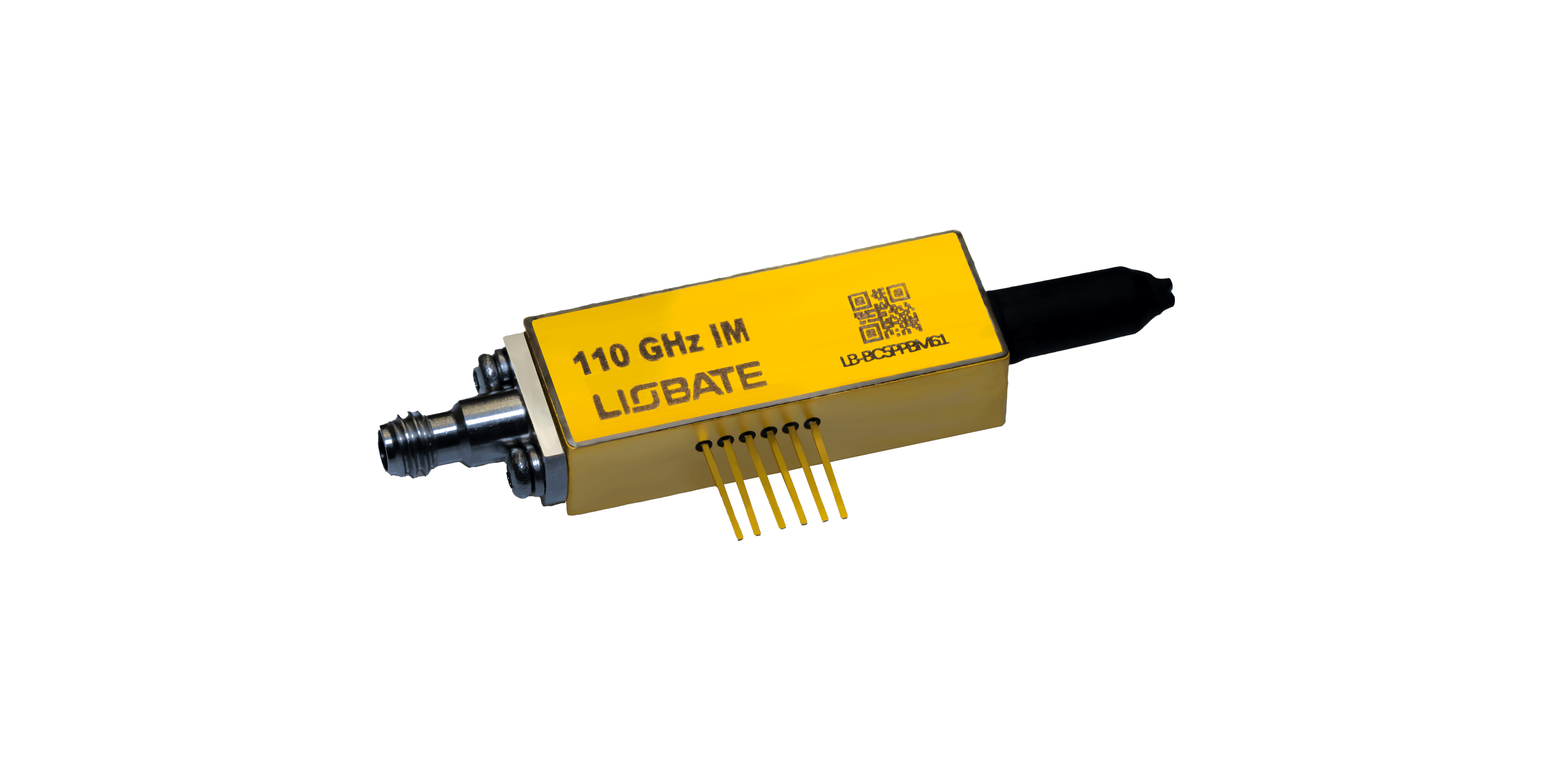
At Liobate, we provide a range of TFLN devices designed for different optical modulation requirements. Our 67/110 GHz Intensity Modulator is a high-speed optical modulator developed for wideband lithium niobate optical modulator applications in test and measurement systems.
This advanced device delivers a 3dB bandwidth of 67/110GHz, enabling high-frequency signal processing for demanding applications. It also features insertion loss of less than 4.5dB and a half-wave voltage below 3.0V, providing efficient modulation performance with reduced power requirements.
With these specifications, our 67/110 GHz Intensity Modulator helps equipment developers and system integrators build accurate and reliable optical testing solutions. It supports applications that require precise signal control, wide bandwidth operation, and stable optical performance.
Applications of TFLN Devices Across Optical Technologies
The advantages of TFLN devices make them suitable for a broad range of photonic applications. In optical communication networks, these devices support high-speed signal transmission by enabling efficient modulation of optical carriers.
In test and measurement environments, optical modulators based on TFLN technology provide the bandwidth and stability needed for evaluating advanced optical components and systems. They help engineers validate performance, analyze signals, and accelerate the development of next-generation communication technologies.
Beyond communication and testing, TFLN devices are also gaining attention in emerging fields that require precise optical control. Their combination of speed, efficiency, and integration capability makes them a valuable technology platform for future photonic innovations.
Supporting the Future of Optical Modulation with TFLN Technology
The continued evolution of optical networks requires components that can deliver higher performance while maintaining efficiency and reliability. TFLN devices provide a strong foundation for advanced optical modulators by offering high bandwidth, low power operation, and excellent signal control.
At Liobate, we are committed to developing innovative thin-film lithium niobate solutions that support the changing needs of the optical industry. Through our advanced TFLN devices and fiber optic modulators, we help customers create more efficient optical communication systems and high-performance measurement platforms.
Enabling Next-Generation Optical Systems Through Innovation
The development of TFLN devices represents an important step forward for optical modulation technology. By combining the advantages of thin-film lithium niobate with advanced photonic engineering, these devices provide the performance required for future high-speed optical systems.
At Liobate, we continue advancing TFLN-based optical modulators to support higher bandwidth, lower energy consumption, and more reliable communication technologies. Our solutions help businesses build the optical infrastructure needed for the next generation of connectivity and photonic innovation.


 The previous article
 Returns the list