The increasing demand for faster and more reliable optical networks requires communication system designers to carefully select components that can balance speed, efficiency, and integration. At Liobate, we understand that choosing the right intensity modulator is essential for building high-performance optical communication systems.
Through our advanced TFLN devices based on thin-film lithium niobate technology, we provide fiber optic modulator solutions with ultra-high bandwidth, low drive voltage, and low insertion loss to support modern telecom and datacom applications.
Understanding the Role of an Intensity Modulator in Optical Systems
An intensity modulator is an important optical component that controls the power level of transmitted light by converting electrical signals into optical intensity changes. It plays an important role in fiber optic communication because it directly affects signal quality, transmission speed, and overall system performance.
For engineers and system developers, selecting an appropriate intensity modulator requires careful evaluation of multiple factors, including bandwidth, insertion loss, half-wave voltage, optical output requirements, and integration flexibility. Different communication scenarios may require different modulator characteristics depending on transmission distance, data rate, and system architecture.
At Liobate, we develop TFLN devices that address these requirements by combining the advantages of thin-film lithium niobate technology with advanced photonic integration. Our solutions are designed to help customers achieve efficient and reliable optical communication performance.
Why TFLN Devices Are Advancing Fiber Optic Modulator Performance
Thin-film lithium niobate has become an important material platform for next-generation optical components because of its excellent electro-optic properties. Compared with traditional optical modulation technologies, TFLN devices provide advantages in bandwidth capability, energy efficiency, and compact integration.
Our TFLN devices are high-performance fiber optic modulators built on proprietary thin-film lithium niobate technology. Each device is designed to deliver ultra-high bandwidth, low drive voltage, and low insertion loss for optical modulator applications.
These characteristics make TFLN devices suitable for a wide range of communication environments, including telecom networks, data communication systems, and emerging high-speed optical applications. By improving modulation efficiency and reducing system limitations, our technology helps engineers design more scalable optical infrastructures.
Key Factors When Selecting an Intensity Modulator
Choosing the right intensity modulator requires understanding how technical specifications influence system performance. Bandwidth is one of the most important considerations because it determines the maximum signal frequency the modulator can support. Higher bandwidth allows optical systems to handle faster data transmission rates.
Insertion loss is another critical parameter. Lower insertion loss helps maintain stronger optical signals throughout the communication link, improving system efficiency and reducing the need for additional signal compensation.
Half-wave voltage is also important when evaluating modulator efficiency. A lower half-wave voltage means the device requires less electrical voltage to achieve effective optical modulation, which can reduce power consumption and simplify driver design.
At Liobate, our TFLN devices are engineered with these factors in mind, providing balanced performance for different optical communication requirements.
Liobate 20/40 GHz Intensity Modulator for Telecom and Datacom
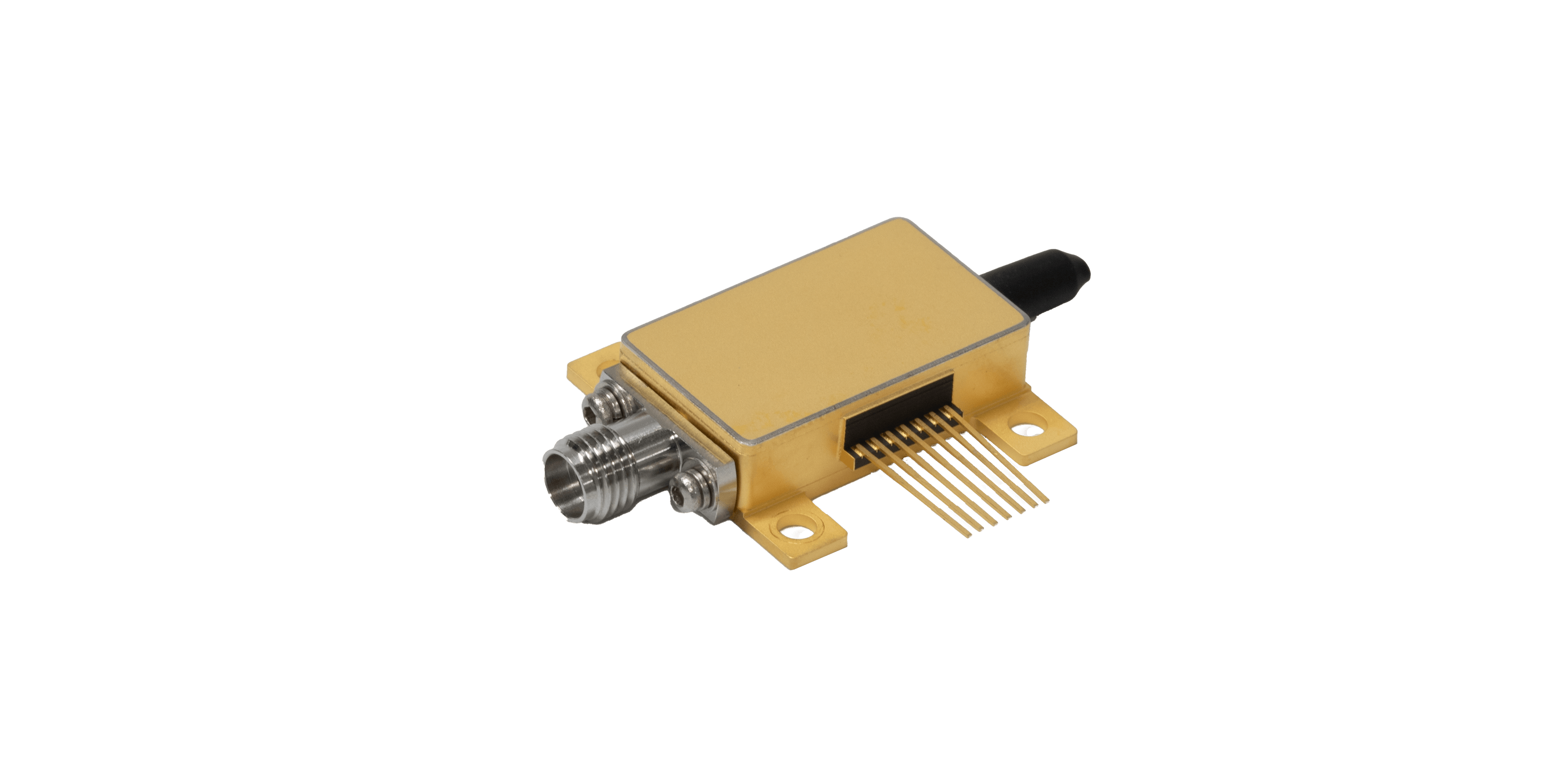
For cost-effective fiber optic communication deployments, our 20/40 GHz Intensity Modulator provides a practical solution with strong performance and compact design. This TFLN-based intensity modulator supports 40GHz bandwidth and is designed for telecom and datacom systems that require reliable high-speed optical modulation.
The device features a 3dB bandwidth of 40GHz, insertion loss below 4.5dB, and half-wave voltage below 3.0V. These specifications enable efficient signal transmission while maintaining low power requirements.
With its combination of bandwidth, low loss, and low drive voltage, this intensity modulator is suitable for applications where system designers need dependable optical performance without unnecessary complexity. It provides an effective option for building high-speed fiber optic communication solutions.
Integrated Solutions with Built-In Light Sources
As optical communication systems become more compact and integrated, reducing component complexity is becoming increasingly important. Integrated modulator solutions can help simplify system design by combining multiple functions into a single device.
Our 20/40 GHz Intensity Modulator with Build-in LD integrates a lithium niobate optical modulator with a low-RIN light source. This design provides 40GHz bandwidth and 12dBm output optical power at the ON state, helping support high-speed optical modulator applications.
The device features a half-wave voltage below 3.0V and integrates a low relative intensity noise (RIN) light source. By combining optical generation and modulation capabilities, it helps engineers reduce design complexity while maintaining high-speed performance.
This integrated approach is valuable for communication systems that require stable optical output, efficient operation, and simplified deployment.
Supporting the Future of Optical Communication Systems
As data traffic continues increasing, optical communication systems must evolve with components that provide higher performance and greater flexibility. Advanced intensity modulators will remain essential for enabling faster transmission speeds and more efficient network architectures.
At Liobate, we continue developing TFLN devices that support the changing needs of optical communication industries. Our fiber optic modulator solutions are designed to help customers improve system performance through advanced materials, optimized designs, and reliable manufacturing capabilities.
By offering a range of TFLN-based optical modulators, we help engineers select solutions that match their application requirements, whether for telecom networks, datacom systems, or future high-speed optical platforms.
Building Efficient Networks with Advanced Modulation Technology
Selecting the right intensity modulator is a crucial step in developing modern optical communication systems. Engineers need solutions that combine bandwidth, efficiency, and reliability to support increasingly demanding applications.
At Liobate, our TFLN devices provide the foundation for next-generation optical modulation with high bandwidth, low insertion loss, and low drive voltage. Through continuous innovation in thin-film lithium niobate technology, we aim to help customers build faster, more efficient, and more scalable optical networks.
As communication requirements continue expanding, Liobate remains committed to delivering advanced photonic solutions that enable the future of optical connectivity.


 The previous article
 Returns the list