Characterizing high-speed optical transceivers, modulators, and coherent receivers demands precise optical measurement equipment. For decades, engineers relied on benchtop setups consisting of discrete tunable lasers, external modulators, polarization controllers, and optical attenuators—each occupying rack space and requiring manual calibration. However, the emergence of thin-film lithium niobate (TFLN) integrated platforms has enabled a new class of compact, automated fiber optic test equipment. We have directly compared conventional benchtop configurations against our TFLN-based EO transmitter solutions across multiple test scenarios. The differences in footprint, ease of use, and measurement repeatability are substantial. Below we share our findings.
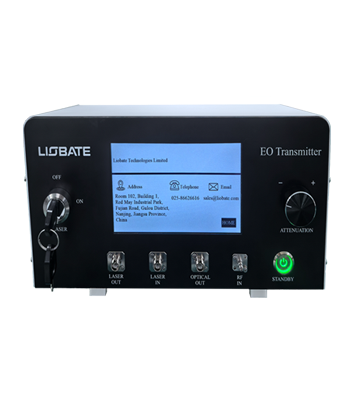
Footprint and Integration Density
A conventional benchtop setup for modulator characterization typically includes a tunable laser source (TLS), a standalone lithium niobate modulator, a polarization controller, a variable optical attenuator (VOA), and an optical power monitor—easily occupying over 6U of rack space. Cabling between these discrete components introduces insertion loss and polarization drift. Our TFLN-based optical measurement equipment integrates a DFB laser, an EO modulator (with customized bandwidth from 40 GHz to 110 GHz), optical monitors, and a VOA into a single compact module. This reduces footprint by more than 80% and eliminates patch cord variability. For production test floors where fiber optic test equipment must be replicated across dozens of stations, this integration translates directly to lower capital expenditure and faster setup times.
Automation and Ease of Operation
Conventional benchtop systems require manual bias control of the external modulator. Engineers must repeatedly adjust DC bias voltages to maintain quadrature, a tedious process that introduces human error and reduces test repeatability. Our TFLN specialized equipment features automated bias control, locking the modulator at the optimal operating point without operator intervention. Integrated optical monitors provide real-time feedback on output power and extinction ratio, while the on-chip attenuator enables power sweeps without external components. The result is optical measurement equipment that is genuinely easy to operate—operators simply set the desired output power and modulation format, and the system self-stabilizes. For R&D labs and manufacturing environments alike, this reduces training time and improves measurement consistency across shifts and locations.
Bandwidth Customization and Performance
Conventional benchtop modulators are typically offered in fixed bandwidths (e.g., 40 GHz or 67 GHz). If a test requires 110 GHz, engineers must purchase a separate, more expensive unit. Our TFLN-based fiber optic test equipment supports customized bandwidth selection from 40 GHz, 70 GHz, to 110 GHz within the same platform—enabling one piece of equipment to cover multiple testing tiers. The integrated DFB laser provides stable, narrow-linewidth optical carriers, and the modulator’s half-wave voltage remains low across the entire bandwidth range. This flexibility is particularly valuable for characterizing next-generation 1.6T transceivers that push beyond 100 GHz symbol rates.
Rethinking Optical Test Strategies
When comparing TFLN-based optical measurement equipment to conventional benchtop solutions, the advantages of integration, automation, and bandwidth customization are clear. What once required a full rack of instruments and a skilled operator can now be accomplished with a single, user-friendly EO transmitter. At Liobate, we are committed to delivering superior TFLN specialized equipment that streamlines your testing workflow. We invite test engineers and production managers to evaluate our EO transmitter solutions—available with integrated DFB laser, optical monitors, attenuator, and automated bias control. Let our fiber optic test equipment become the new standard in your lab or factory floor.


 The previous article
 Returns the list