Behind every precision measurement in fiber optic communications—bandwidth characterization, dispersion analysis, or component linearity testing—lies a set of physical principles that govern how light interacts with electric fields and material properties. Modern optical measurement equipment relies heavily on the electro-optic effect: the ability of an applied voltage to change the refractive index of a crystal, thereby modulating the phase, intensity, or frequency of light. For decades, bulk lithium niobate served as the workhorse material. However, the transition to thin-film lithium niobate (TFLN) has fundamentally altered what is possible. By understanding the underlying physics of TFLN Devices and their role as a high-speed optical modulator, engineers can make more informed decisions when selecting or designing test systems. Below we examine three key physical principles that enable today’s advanced measurement platforms.
The Electro-Optic Effect and Waveguide Confinement
The linear electro-optic (Pockels) effect causes the refractive index to change proportionally to an applied electric field. In bulk crystals, the field is applied across a relatively thick substrate, requiring high voltages (Vπ often >5 V) to achieve a π phase shift. TFLN Devices exploit a different physics: the optical mode is confined within a sub‑micron thin film, and the RF electrodes are placed in close proximity. This tight field‑mode overlap produces a much stronger interaction, lowering the half‑wave voltage to <2.5 V at 25 GHz RF bandwidth. For optical measurement equipment, lower Vπ means that standard electronic drivers can be used without power amplifiers, reducing noise and improving measurement fidelity. Our 1‑level optical frequency comb achieves this with insertion loss below 9 dB, directly enabling compact, integrated test instruments.
Phase Modulation and Optical Frequency Comb Generation
When a sinusoidal voltage is applied to a high-speed optical modulator, it generates sidebands at multiples of the RF frequency. This is the physical basis of an optical frequency comb: cascading phase modulation stages produces a spectrum of equally spaced, phase‑locked lines. The number of usable comb lines depends on the modulation depth, which is proportional to Vπ. With TFLN Devices achieving <2.5 V Vπ, even a single modulator driven at 25 GHz creates a broad, flat 1‑level comb. For more demanding applications, a customizable 3‑level comb multiplies the number of tones by cascading three modulator stages on the same chip. Understanding this physics helps explain why optical measurement equipment such as optical spectrum analyzers and chromatic dispersion test sets now integrate comb sources—they replace multiple tunable lasers with a single, stable, phase‑locked reference.
Integration and Signal Integrity in Test Systems
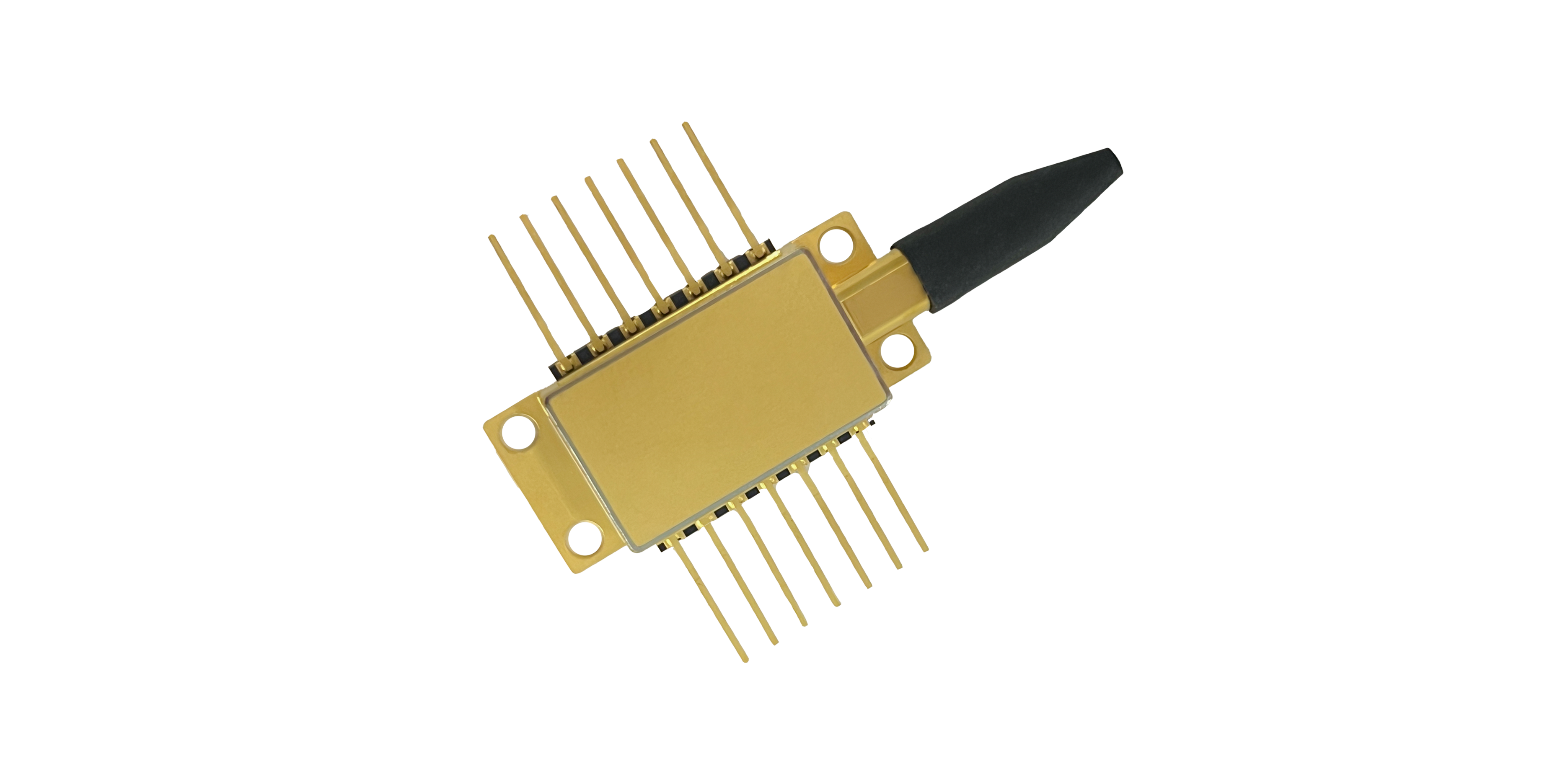
Modern optical measurement equipment also benefits from the physics of integration. When a high-speed optical modulator is integrated with a DFB laser, optical monitors, and an attenuator on a single TFLN chip, the path lengths between components are minimized. This reduces parasitic capacitance, inductance, and thermal drift—all of which degrade measurement repeatability. Our TFLN Devices offer high integration and compact size, meaning that an entire EO transmitter fits in a small module. For test engineers, this translates to fewer calibration steps and faster settling times. The customizable 3‑level comb further demonstrates physical integration: three modulator stages, each with independent bias control, fit within a footprint that previously held only one bulk modulator.
From Physics to Practice
Understanding the fundamental physics of TFLN Devices reveals why they outperform legacy platforms in optical measurement equipment. Lower Vπ, tighter field confinement, and monolithic integration are not incremental improvements—they represent a paradigm shift. At Liobate, we are committed to applying these principles to build superior high-speed optical modulator solutions, from 1‑level frequency combs to fully customizable 3‑level systems. We invite test and measurement specialists to experience how our TFLN‑based equipment combines physical insight with practical performance. Let the physics guide your next instrument choice.


 The previous article
 Returns the list