The continuous development of photonics technology is creating new opportunities for industries that require extremely accurate measurement, high-speed signal processing, and advanced optical control. From scientific research to industrial sensing, precision applications increasingly depend on reliable optical solutions with high integration and performance.
At Liobate, we develop advanced thin-film lithium niobate technologies to support these demands. Our TFLN devices provide high-performance fiber optic modulation solutions, including optical frequency comb technologies designed for photonics and precision measurement applications.
Understanding the Role of Optical Frequency Comb Technology
An optical frequency comb is an advanced photonic technology that generates a series of evenly spaced optical frequency lines. These precisely controlled frequency components create a “comb-like” spectrum, enabling highly accurate measurement and signal processing.
Because of its exceptional frequency stability and accuracy, optical frequency comb technology has become valuable in applications such as spectroscopy, optical frequency synthesis, precision timing, and advanced sensing. By providing precise frequency references, optical frequency comb systems allow researchers and engineers to measure optical signals with extremely high resolution.
As industries demand more compact and efficient solutions, integrating optical frequency comb functions into photonic systems has become an important development direction. Advanced materials and integrated photonic technologies are helping make these systems smaller, more reliable, and easier to deploy.
How Liobate TFLN Devices Support Advanced Photonic Applications
At Liobate, we offer a complete range of TFLN devices built on thin-film lithium niobate technology. These high-performance fiber optic modulators are designed to deliver ultra-high bandwidth, low drive voltage, and low insertion loss for optical modulator applications.
Thin-film lithium niobate provides excellent electro-optic properties, making it suitable for high-speed modulation and precision optical control. By combining TFLN material advantages with advanced photonic integration, our devices help customers develop optical systems with improved efficiency and performance.
Our TFLN devices support a wide range of applications, including optical communication, test instruments, sensing systems, and precision measurement technologies. These solutions enable businesses and research organizations to create compact optical platforms without compromising performance.
Optical Frequency Comb Applications in Precision Measurement
Optical frequency comb applications are expanding rapidly because they provide highly accurate frequency control for measurement systems. In spectroscopy, frequency combs can improve the ability to analyze materials and chemical compositions by providing precise optical references.
In optical frequency synthesis, frequency comb technology helps generate stable and accurate optical signals across different frequency ranges. This capability is valuable for applications requiring precise timing, calibration, and synchronization.
For industrial and scientific environments, compact and reliable frequency comb solutions can simplify system design. By integrating optical frequency comb functions with TFLN-based photonic devices, engineers can develop more efficient platforms for demanding measurement tasks.
Liobate Optical Frequency Comb Device Features
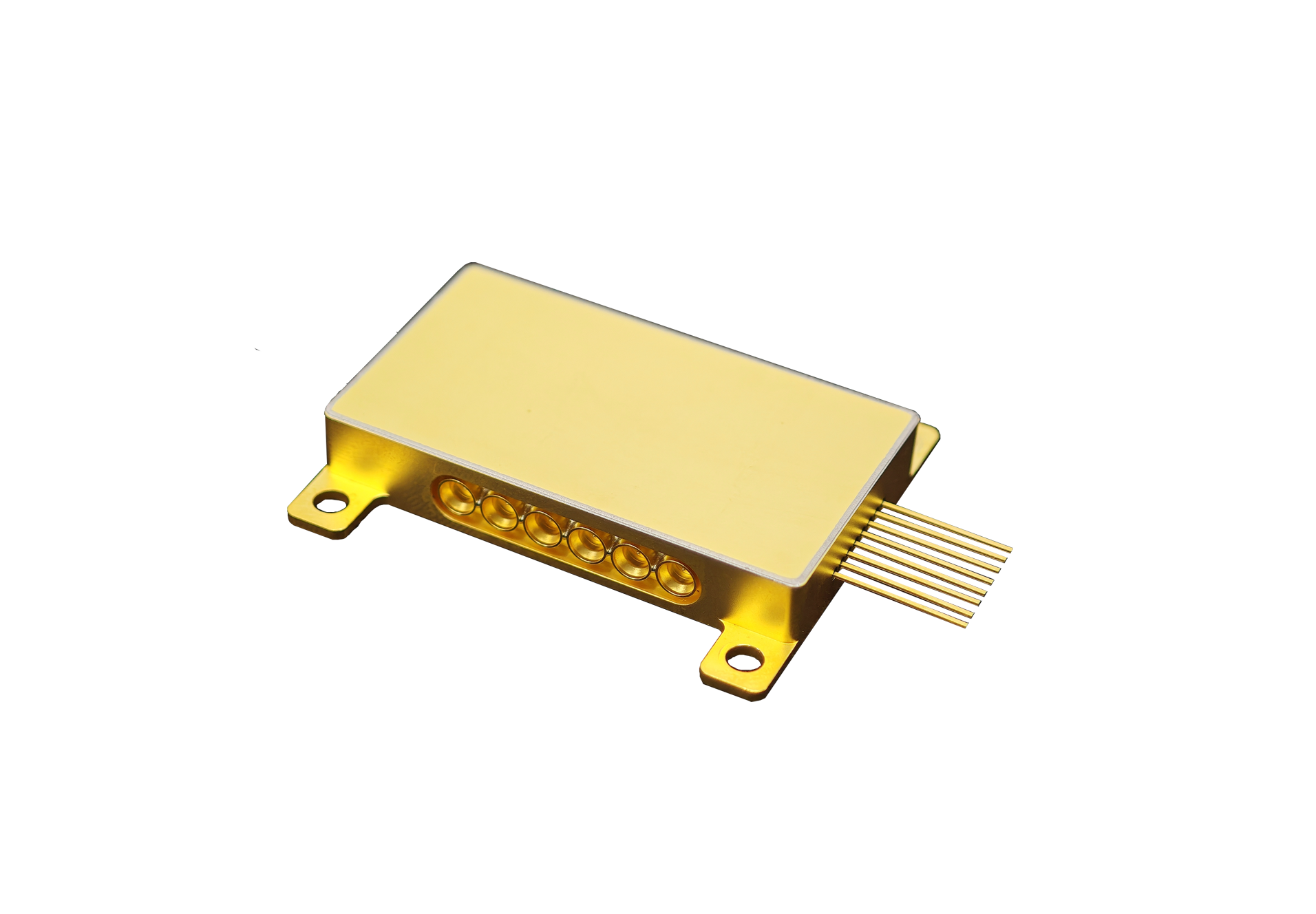
Our optical frequency comb device is designed for precision TFLN modulator applications in spectroscopy and optical frequency synthesis. It features a 25GHz RF bandwidth and supports customizable 3-level configurations, providing flexibility for different system requirements.
The 1-level optical frequency comb configuration delivers strong performance with an RF bandwidth of 25GHz, half-wave voltage below 2.5 V, and insertion loss below 9 dB. These specifications enable efficient optical modulation while maintaining compact integration.
In addition to high performance, our optical frequency comb device offers high integration and compact size. This design advantage allows system developers to create smaller photonic platforms while maintaining accurate frequency control.
The customizable 3-level optical frequency comb capability further improves application flexibility. Customers can adapt the configuration according to specific measurement and photonic system requirements.
The Advantages of TFLN Technology for Frequency Comb Systems
The performance of an optical frequency comb system depends heavily on the quality of its modulation components. TFLN technology provides several advantages that make it suitable for advanced frequency comb applications.
First, thin-film lithium niobate enables high-speed modulation because of its strong electro-optic response. This allows optical systems to process signals efficiently while maintaining precise control.
Second, TFLN devices support low drive voltage operation, helping reduce energy consumption and improve system efficiency. This is especially important for compact photonic systems that require continuous operation.
Third, the integration capability of TFLN technology allows optical components to be combined into smaller platforms. This helps reduce system complexity and supports the development of portable and scalable measurement solutions.
Creating Future Possibilities with Liobate Photonic Solutions
The demand for accurate measurement and advanced optical control continues to grow across scientific, industrial, and communication fields. Optical frequency comb technology provides a powerful foundation for applications requiring exceptional precision and stability.
At Liobate, we are committed to advancing TFLN devices that support next-generation photonic systems. Through our thin-film lithium niobate solutions, we provide high-performance modulation technologies that combine bandwidth, efficiency, and compact integration.
Our optical frequency comb device demonstrates how TFLN technology can support precision measurement and advanced photonic applications. By continuing to develop innovative optical solutions, we aim to help businesses and researchers achieve greater accuracy, efficiency, and performance in future optical systems.


 The previous article
 Returns the list