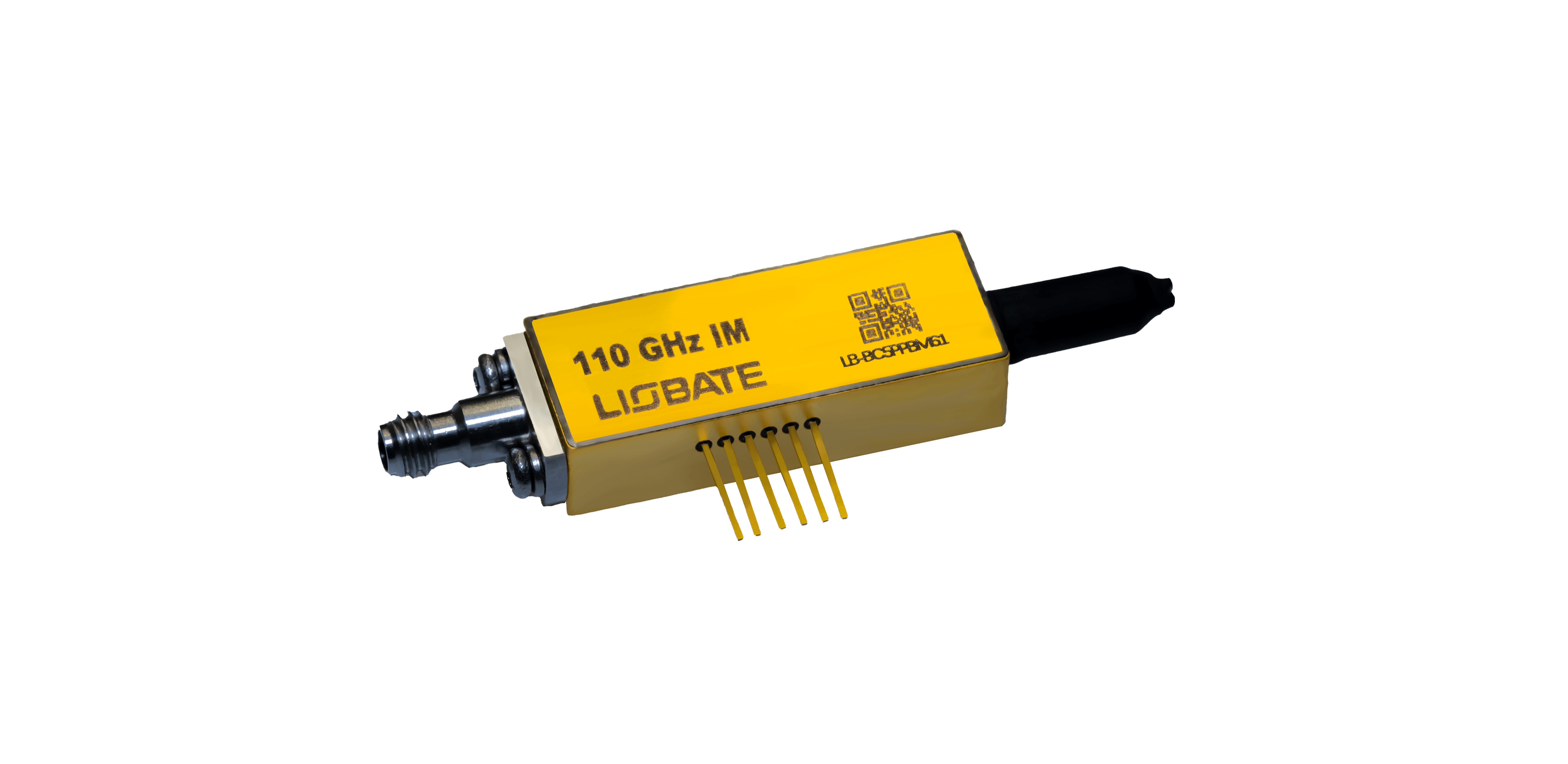
When architecting optical links for data centers, telecom networks, or test instruments, engineers face a fundamental choice: directly modulate the laser diode (DML) or use a continuous-wave laser followed by an external high speed optical modulator. Each approach has passionate advocates, yet their performance envelopes differ dramatically—especially as symbol rates exceed 50 Gbaud. Direct modulation offers simplicity and lower component count, but external modulation using TFLN Devices unlocks bandwidth, linearity, and reach that DMLs cannot match. Through extensive characterization of our thin film lithium niobate modulator platforms (67 GHz and 110 GHz intensity modulators), we have quantified these differences. Below we compare both technologies across three critical dimensions.
Bandwidth and Chirp Limitations
Direct modulated lasers modulate output power by varying the laser’s injection current. This process inevitably introduces frequency chirp—a modulation of the optical wavelength that broadens the signal spectrum and degrades transmission reach due to fiber dispersion. At speeds beyond 25 Gbaud, DML chirp becomes severe, limiting links to a few kilometers on standard single‑mode fiber. In contrast, an external thin film lithium niobate modulator operates on a continuous‑wave, chirp‑free laser. Our TFLN Devices deliver 67 GHz or 110 GHz 3 dB bandwidth with negligible residual chirp, enabling error‑free transmission over tens of kilometers even at 800G line rates. For short‑reach data center interconnects, DMLs may suffice, but for any link requiring distance or high‑order modulation, the external modulator wins decisively.
Drive Voltage and Power Efficiency
Modern DMLs require bias currents of tens of milliamps and modulation currents that scale with speed. At 50 Gbaud, the driver power for a DML can approach 1 W. A high speed optical modulator based on TFLN Devices consumes negligible DC current (only bias voltage) and requires RF drive power proportional to the square of the modulation swing. Our thin film lithium niobate modulator achieves a half‑wave voltage below 3.0 V differential, allowing CMOS‑compatible drive levels. For a 67 GHz or 110 GHz link, the total modulator driver power is often lower than that of a comparable DML driver, especially when considering the laser’s continuous bias power. The insertion loss of our device (< 4.5 dB) is compensated by the higher output power available from a standalone CW laser, making the total link budget competitive.
Linearity and Modulation Formats
For coherent communications using QPSK, 16QAM, or 64QAM, modulator linearity is paramount. DMLs exhibit inherent nonlinearity due to the laser’s gain curve and thermal effects, limiting their use to simple on‑off keying (OOK) or PAM‑4 at modest speeds. An external thin film lithium niobate modulator provides exceptional linearity across its entire bandwidth, thanks to the linear electro‑optic effect. Our TFLN Devices maintain > 25 dB extinction ratio and low intermodulation distortion, supporting complex modulation formats with low error‑vector magnitude. For next‑generation 1.6T coherent pluggables, this linearity is non‑negotiable.
Making the Right Choice
Direct modulated lasers excel in low‑cost, short‑reach applications up to 25 Gbaud. But for 800G, 1.6T, or any link requiring high bandwidth, low chirp, and linear response, an external high speed optical modulator based on TFLN Devices is the superior engineering choice. Our thin film lithium niobate modulator platforms—available with 67 GHz or 110 GHz bandwidth, < 4.5 dB loss, and < 3.0 V Vπ—provide a clear path forward. At Liobate, we are committed to delivering these advanced modulators for your most demanding optical systems. We invite you to compare our specifications against any DML‑based solution and see the difference for yourself.


 The previous article
 Returns the list