As the global demand for ubiquitous, high-speed wireless connectivity continues to surge, we are witnessing a fundamental convergence of optical and wireless technologies. The rollout of 5G-Advanced and the early research into 6G have highlighted a significant bottleneck in traditional copper-based fronthaul and midhaul networks. At Liobate, we believe that the most effective way to overcome these geographical and bandwidth limitations is through Radio-over-Fiber (RoF) technology. By utilizing advanced optical modulators, we can now transport high-frequency radio signals over long distances with minimal degradation, revolutionizing the way we deploy cellular and satellite communications.
The Strategic Value of Radio-over-Fiber in B2B Wireless Infrastructure
Radio-over-Fiber is a technology where light is modulated by a radio frequency (RF) signal and transmitted over an optical fiber link. This approach allows us to centralize the complex signal processing at a "Head-End Unit" (HEU), while leaving the "Remote Antenna Units" (RAUs) as simple, low-power nodes. For our B2B partners in the telecommunications and defense sectors, this architecture offers a dual advantage: it significantly reduces the Capital Expenditure (CAPEX) per site and lowers the Operational Expenditure (OPEX) by simplifying maintenance and reducing power consumption at the edge.
However, the success of an RoF system is entirely dependent on the linearity and bandwidth of the electro-optic interface. Traditional modulation techniques often struggle with high-frequency RF signals, particularly in the millimeter-wave (mmWave) spectrum. This is where the integration of TFLN Devices becomes a game-changer for the industry.
Enhancing RoF Performance with TFLN Devices
Thin-Film Lithium Niobate (TFLN) technology provides the ideal physical platform for the high-performance modulation required by modern RoF architectures. When we design RoF systems, we are essentially looking for three things: high frequency response, low insertion loss, and high linearity to maintain the integrity of complex modulation formats like 256-QAM or 64-QAM.
Our research and development into TFLN Devices have allowed us to surpass the limitations of bulk lithium niobate. In an RoF context, TFLN technology enables:
Wideband RF Signal Transport: Unlike silicon photonics, which can suffer from carrier-depletion limits, our TFLN Devices offer a flat frequency response into the V-band and W-band. This allows for the direct transport of 60 GHz and even 100 GHz signals without the need for complex frequency down-conversion at the antenna site.
Superior Linearity for Analog Signals: RoF is essentially an analog optical application. We ensure that our modulators maintain a high Spurious-Free Dynamic Range (SFDR). High linearity is crucial because it minimizes the intermodulation distortion that can interfere with adjacent wireless channels.
Power-Efficient Remote Nodes: By leveraging our thin-film platform, we can drive these optical modulators with lower-power RF amplifiers. This is a critical factor for B2B deployments in remote or densely packed urban environments where heat dissipation and power availability are primary concerns.
Technical Specifications: The Liobate RoF Advantage
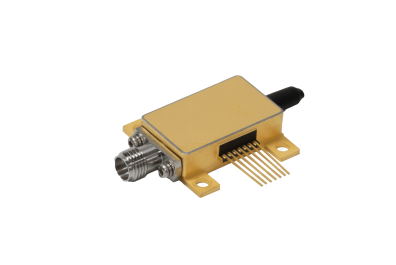
To provide our clients with the precision they require, we maintain rigorous standards across our product line. Our TFLN-based intensity modulators and phase modulators are specifically optimized for the high-fidelity requirements of analog optical links.
These standards ensure that when we implement an RoF link, the optical segment does not become the bottleneck. The low insertion loss of less than 4.0 dB is particularly important for long-reach fronthaul, where every decibel of power budget is vital for maintaining the Signal-to-Noise Ratio (SNR).
Addressing the B2B Challenges of Signal Integrity
In professional wireless infrastructure, signal integrity is non-negotiable. One of the common issues we encounter in RoF troubleshooting is the impact of fiber dispersion on the modulated signal. In standard RoF setups, fiber dispersion can cause "power fading" at certain RF frequencies. To mitigate this, Liobate offers advanced TFLN-based Single Sideband (SSB) modulators. By suppressing one of the sidebands, we can effectively eliminate dispersion-induced fading, allowing for much longer transmission distances in the C-band.
Furthermore, our TFLN Devices are designed with a high refractive index contrast, which allows for tighter mode field diameters. This results in devices that are not only more efficient but also more compact, enabling the high-density integration required for massive MIMO (Multiple-Input Multiple-Output) antenna arrays.
The Role of Liobate in the Future of RoF
As an industry leader in TFLN technology, Liobate is committed to pushing the boundaries of what is possible in optical-wireless convergence. We recognize that the future of B2B communication lies in the seamless integration of these two domains. Whether it is providing the backbone for 5G small cells or enabling the high-throughput ground stations for Low Earth Orbit (LEO) satellite constellations, our optical modulators are at the heart of the connectivity revolution.
Our vertical integration—from raw material processing to final chip packaging—allows us to customize the modulation characteristics to meet specific RoF link budgets. We work closely with system integrators to ensure that our TFLN Devices provide the reliability and stability required for mission-critical infrastructure.
Conclusion: Scaling Wireless Networks with Optical Precision
In conclusion, Radio-over-Fiber is no longer a niche technology; it is a foundational pillar of modern wireless architecture. By offloading the complexity of RF processing to a central location and using fiber as a transparent transport medium, we can build networks that are more flexible, scalable, and energy-efficient.
At Liobate, we are proud to provide the high-performance optical modulators that make this possible. Our continuous investment in TFLN Devices ensures that our partners have access to the most advanced electro-optic components on the market. We invite you to contact our engineering team to discuss how our TFLN solutions can optimize your next RoF project and help you navigate the complexities of high-frequency signal transport. Together, we are turning the potential of light into the power of communication.


 The previous article
 Returns the list