In the rapidly evolving landscape of high-capacity optical communications, we are witnessing a paradigm shift. As data centers and telecommunication infrastructures move toward 800G and 1.6T transmission rates, the physical limitations of legacy materials have become unavoidable. Among these challenges, polarization dependency remains a critical hurdle for system architects. At Liobate, we recognize that maintaining signal integrity across complex fiber-optic links requires more than just raw bandwidth—it requires a fundamental shift in how we handle light.
The Challenge of Polarization in Modern Fiber Optic Modulators
Traditionally, lithium niobate has been the gold standard for electro-optic modulation due to its high Pockels coefficient. However, the intrinsic anisotropy of the crystal means that modulation efficiency is highly dependent on the polarization state of the incoming light. In a standard X-cut configuration, the transverse-electric (TE) mode aligns perfectly with the crystal's strongest electro-optic axis, while the transverse-magnetic (TM) mode experiences significantly degraded performance.
In real-world B2B deployments, this creates a "Polarization Dependent Loss" (PDL) that can destabilize long-haul links and coherent systems. While polarization-maintaining fibers (PMFs) offer a partial solution, they introduce prohibitive costs and packaging complexities that hinder scalability. We believe the industry deserves a more elegant, integrated approach.
Troubleshooting Polarization with Next-Generation TFLN Devices
To address these systemic inefficiencies, we have focused our R&D on TFLN Devices (Thin-Film Lithium Niobate). By transitioning from bulk crystals to thin-film-on-insulator technology, we can leverage much tighter optical confinement. This structural advantage allows for the integration of advanced on-chip polarization management components that were previously impossible to implement at scale.
When we troubleshoot polarization dependency, we look at three core architectural strategies:
Integrated Polarization Splitter-Rotators (PSR): We can now monolithically integrate PSRs that split incoming light into orthogonal components, rotating the TM mode into a TE mode. This ensures that both components are modulated with maximum efficiency before being recombined.
Dual-Mode Modulation: Our TFLN platform supports the conversion of TM0 modes into higher-order TE1 modes. By modulating both TE0 and TE1 modes simultaneously using shared electrodes, we achieve polarization-insensitive operation without the footprint of redundant circuits.
Ultra-Low Half-Wave Voltage: By reducing the gap between electrodes to the micrometer scale, our TFLN Devices achieve sub-2V driving voltages. This high efficiency compensates for minor polarization-related fluctuations, ensuring a stable signal-to-noise ratio (SNR) across the C and L bands.
Precision Specifications of Liobate TFLN Solutions
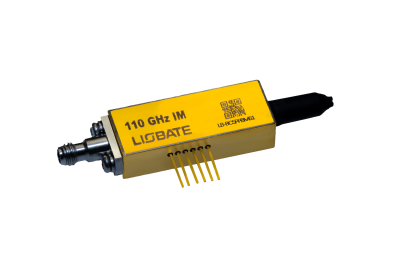
In the B2B sector, performance is measured by precision. We have engineered our product lineup to meet the most demanding specifications in the industry. Our current TFLN Devices, such as our 67/110 GHz Intensity Modulators, are designed to eliminate the bottlenecks found in traditional silicon photonics and bulk LN.
Parameter | Specification (High-Performance Series) |
3dB-Bandwidth | 67 GHz / 110 GHz |
Insertion Loss | < 4.5 dB (Including coupling loss) |
These specs represent our commitment to the "Low Power, High Speed" mantra of modern photonics. By maintaining an insertion loss below 4.5 dB and a bandwidth exceeding 110 GHz, our modulators provide the head-room needed for 1.6T DR8 and ZR coherent applications.
Why Liobate Leads the TFLN Revolution
As an IDM (Integrated Device Manufacturer), Liobate controls the entire value chain—from wafer-scale fabrication on 4-inch and 6-inch substrates to advanced high-frequency packaging. This vertical integration is what allows us to solve the polarization problem at the chip level rather than forcing our clients to solve it at the system level.
Our proprietary etching processes ensure that our ridge waveguides have a high refractive index contrast, which is the key to maintaining low PDL and high EO bandwidth. Furthermore, we have successfully addressed the "bias drift" issue common in optical modulators, providing our B2B partners with devices that offer highly stable and repeatable performance over long operational lifecycles.
Integrating the Future of Optical Communications
The transition to Liobate TFLN technology is not just an upgrade; it is a strategic necessity for companies building the AI-driven data centers of tomorrow. When we look at the requirements for Co-Packaged Optics (CPO) and 1600ZR+ standards, it is clear that the superior electro-optic properties of thin-film lithium niobate are the only path forward.
By utilizing our TFLN Devices, system integrators can reduce the complexity of their digital signal processing (DSP) and eliminate the need for power-hungry non-linear equalizers. This results in a leaner, cooler, and faster optical interconnect.
Conclusion: A Strategic Partnership for High-Speed Data
At Liobate, we are more than just a component supplier; we are a partner in solving the most complex challenges in photonics. Whether you are troubleshooting polarization dependency in a new coherent transceiver design or looking to reduce the power envelope of your next-generation switch, our team of experts is ready to provide the high-performance optical modulators your project demands.
We invite you to explore our full range of TFLN Devices and witness how we are redefining the limits of light. Together, we can build a faster, more reliable, and more efficient global communication network.


 The previous article
 Returns the list