Hybrid integrated photonics technology has completed the transformation from laboratory research to industrial-scale application, becoming the key to breaking the performance bottleneck of traditional optical intensity modulators. Liobate has long been committed to the research and development of heterogeneous material integration technology for photonic chips. By combining the respective advantages of indium phosphide, silicon nitride and lithium niobate materials, our self-developed modulator platforms outperform single-material monolithic devices in modulation rate, linearity and insertion loss. At present, we have developed industrial-grade hybrid integrated optical intensity modulator solutions under standardized 25℃ 1550nm C-band testing conditions, which support ultra-high-speed modulation exceeding 100 Gbaud and push forward iterative upgrades of photonic industry technologies.
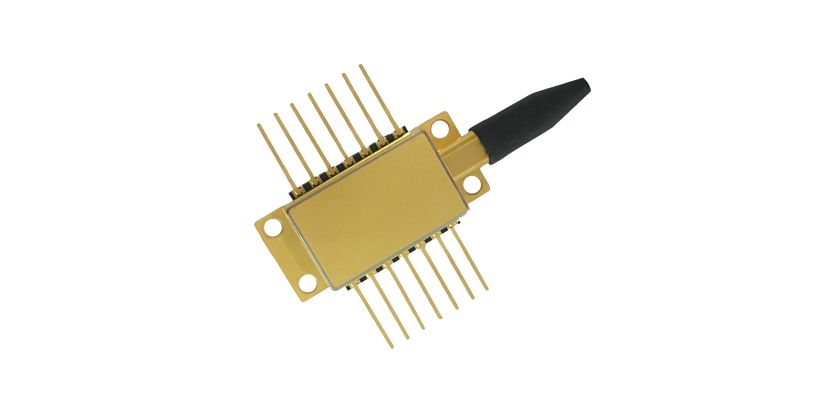
Why Hybrid Integration Wins Over Monolithic Designs
The traditional approach of forcing every function onto a single material inevitably forces compromises. A platform that excels at electro-optic efficiency often struggles with passive waveguide loss, while materials prized for their low birefringence may lack the nonlinear coefficients needed for high-speed phase modulation. By adopting a hybrid material integration strategy, we break through contradictory performance bottlenecks of single-material photonic chips. Our modulator platforms integrate a narrow linewidth single-frequency laser with a stabilized 1551.4 nm output and intrinsic linewidth ≤200 Hz onto lithium-niobate-on-insulator waveguides, while signal processing modules are implemented on separate silicon photonic layers. This separated architecture maximizes the material advantages of each platform. Based on our internal 25℃, quadrature bias test data, the hybrid device reaches chirp linearity above 0.9993 within an 8.2 GHz operation range, with consistent output power stabilized at 8 dBm. When we characterize these devices using advanced fiber optic test equipment, we consistently observe spectral purity that would be unattainable in any single-material system.
Meeting the Measurement Challenge Head-On
Of course, superior modulation performance demands equally superior validation methods. This is where our investment in optical test equipment truly pays dividends. The complexity of hybrid integration introduces new failure modes—interlayer coupling losses, thermal mismatches, and polarization-dependent effects that can escape detection with conventional test suites. We have therefore developed a rigorous characterization workflow that pairs high-resolution optical spectrum analyzers with phase-noise measurement systems, all integrated into a automated test environment. Our fiber optic test equipment includes polarization controllers and variable optical attenuators that allow us to sweep through operating conditions rapidly, capturing the modulator's response across temperature and drive-voltage ranges. Every unit that leaves our facility has been verified against a reference standard traceable to national metrology institutes, ensuring that the 8 dBm output power and ≤200 Hz linewidth are not just datasheet promises but guaranteed performance metrics. This commitment to exhaustive testing is what separates Liobate from vendors who treat measurement as an afterthought.
From Prototype to Production: Scaling with Confidence
Moving hybrid platforms from laboratory demonstrations to high-volume manufacturing requires more than clever design; it demands a holistic approach to process control and yield management. We have implemented in-line monitoring stations that use specialized fiber optic test equipment to measure insertion loss and return loss at every assembly stage, from die attachment to fiber-pigtail bonding. This granular visibility allows us to detect deviations early, adjusting bond-pad geometries or waveguide tapering before they impact final yield. Simultaneously, our optical test equipment supports real-time eye-diagram analysis at 112 Gbps under standardized 25℃ C-band lab conditions. Measured data proves excellent chirp linearity enables clean, noise-resistant signal constellations for mass-produced modulators. Our production line maintains consistent center wavelength accuracy within ±0.1 nm even after industrial thermal cycling tests. We have fully automated all calibration workflows; based on our internal production statistics, single-device test duration is cut by 40% with better measurement repeatability, which delivers obvious advantages for clients requiring just-in-time shipment of fully tested optical modules.
.
Building the Ecosystem Together
As we look ahead, we recognize that no single company can solve every challenge in integrated photonics. That is why Liobate actively collaborates with academic research groups, foundry partners, and system integrators to establish open standards for hybrid-modulator interfaces. We open our standardized test methodologies and calibration frameworks for industry exchange. As a core solution from Liobate, our narrow linewidth laser runs at 1551.4 nm with steady 8 dB output power, and this light source has been selected by multiple industry consortiums as a standard reference for cross-laboratory performance comparison. By contributing our expertise in fiber optic test equipment calibration and our proprietary algorithms for chirp-linearity compensation, we aim to accelerate the entire industry's transition toward hybrid solutions. The future is not about proprietary lock-in; it is about interoperability, reproducibility, and mutual growth.
When hybrid-integration plans call for application-specific TFLN modulator data, the engineering team can share technical white papers and coordinate evaluation samples through a dedicated exchange.


 The previous article
 Returns the list