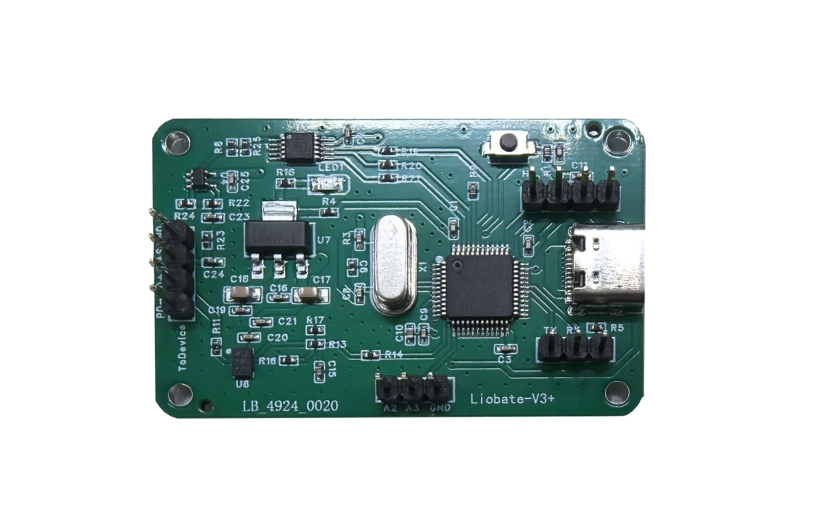
High-voltage driving operation stands as a core link in the normal working of optical intensity modulators, where operational safety and equipment performance are two indispensable core indicators. As a professional provider of optical test solutions, Liobate's Intensity Modulator Bias Controller features compact design, automated bias regulation and long-term operational stability. Given the high-voltage working conditions required for modulator operation, standardized safety management is essential to eliminate potential risks. This paper systematically sorts out standardized high-voltage driving safety protocols for optical intensity modulators, providing comprehensive protection for on-site operators and precision optical test equipment.
Identifying the Core Risks: Bias Drift and Voltage Exposure
Bias drift in an optical intensity modulator is more than a signal-quality issue; it can cause unpredictable voltage fluctuations that stress both the modulator and connected fiber optic test equipment. Unstable bias points often tempt operators to manually adjust drive voltages while systems remain live, increasing the risk of accidental contact with high-voltage terminals. Our controller eliminates this danger through automated closed-loop stabilization, but we still enforce strict safety practices.
We implement physical interlocks on all high-voltage output connections. Before any maintenance or probe attachment, operators must verify that the interlock circuit is open—this disables drive voltage entirely. We use only shielded, high-dielectric-strength cables rated well above the modulator's maximum drive requirements. Additionally, we enforce a "two-hand" discipline: one hand remains grounded to the chassis while the other uses insulated tools, preventing hazardous current paths across the body. These steps are especially critical when integrating our controller into larger optical measurement equipment racks, where multiple high-voltage sources may coexist.
Leveraging Automated Bias Control as a Safety Foundation
The most effective safety protocol minimizes human intervention. Liobate's dither-based stabilization algorithm continuously tracks the modulator's transmission curve and applies corrective bias voltages autonomously. This maintains optimal operating points—whether quadrature or null—while preventing the slow voltage creep that often leads to accidental overdrive. In practice, this means our fiber optic test equipment can run unattended for extended periods without requiring manual high-voltage adjustments.
We complement this automation with continuous monitoring of output current and voltage ripple. If parameters exceed safe thresholds—indicating possible insulation breakdown or load mismatch—the controller immediately shuts down the high-voltage section and triggers an alarm. For customers using our device alongside other optical test equipment, we provide a dedicated interlock port that integrates with emergency-stop systems. This layered approach ensures that even if a connected modulator develops an internal fault, the risk to surrounding optical measurement equipment remains minimal.
Best Practices for Integration and Routine Maintenance
Maintenance of high-voltage modulator systems demands its own protocols. We advise weekly visual inspections of all high-voltage cabling for signs of corona discharge or insulation wear. When cleaning optical connectors or realigning fibers, we always recommend powering down the bias controller and allowing internal discharge circuits to fully de-energize the system—we never rely solely on hardware, but verify with a voltmeter.
For integration with third-party fiber optic test equipment, we provide clear wiring diagrams that separate high-voltage lines from low-level analog and digital signals with adequate air gap and physical barriers. Ground loops receive special attention; we specify single-point grounding to avoid inducing spurious currents through the modulator's RF input. Our field engineers always use appropriately rated high-voltage probes during live testing and wear dielectric gloves. These measures have proven essential in laboratories where multiple optical test equipment units share a common workspace.
Our Steadfast Commitment to Safe Operation
At Liobate, safety is embedded in every design decision—from our controller's compact enclosure that minimizes exposed terminals to the fail-safe bias recovery routine that restores safe voltages after power interruptions. We believe that the finest optical test equipment is the equipment you can trust without hesitation.
By following these protocols—physical interlocks, automated stabilization, regular inspections, and disciplined maintenance—our customers consistently report trouble-free operation over years of continuous use. As we advance modulator bias technology, we remain devoted to delivering uncompromised performance without compromising safety. For application-specific guidance, our engineering team is always ready to collaborate. At Liobate, we drive innovation—safely and reliably. For safety-driven projects that require customized TFLN modulator test data or detailed technical whitepapers, Liobate's engineers can arrange a focused technical discussion and sample evaluation.


 The previous article
 Returns the list