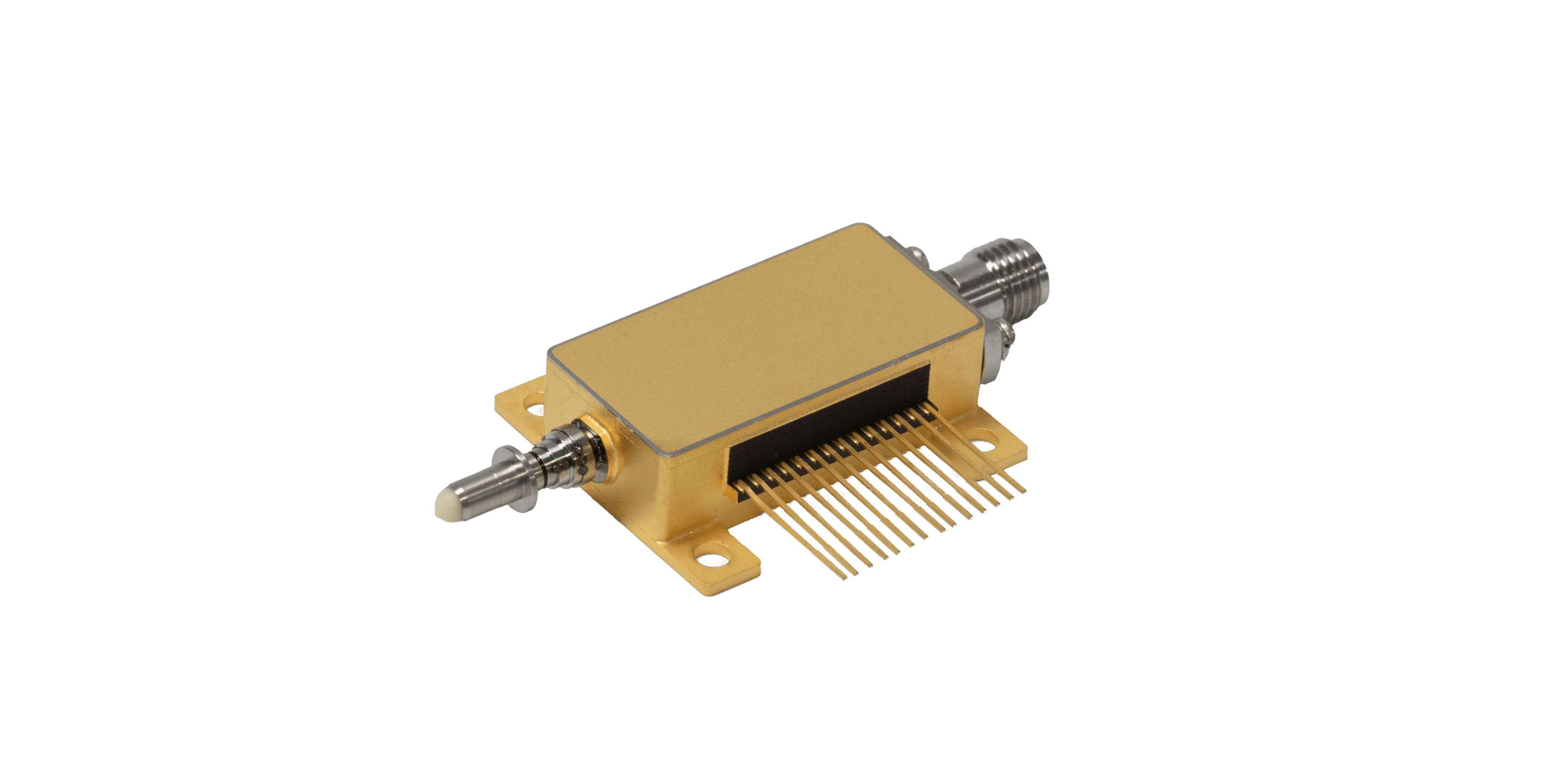
Half‑wave voltage (Vπ) is arguably the most critical parameter for any intensity modulator. It defines the voltage required to shift the optical phase by π radians, directly impacting driver requirements, power consumption, and linearity. Yet measuring Vπ accurately—especially for modern wide‑bandwidth TFLN Devices—presents subtle challenges. Optical test engineers must account for impedance mismatch, frequency dependence, and thermal drift. Drawing on our experience characterizing TFLN Devices such as the 20/40 GHz intensity modulator (40 GHz bandwidth, <4.5 dB insertion loss, <3.0 V Vπ), we outline reliable measurement methods that deliver repeatable results.
DC and Low‑Frequency Vπ Measurement
The simplest method applies to DC or very low frequencies (e.g., <1 kHz). Direct the output of a continuous‑wave laser through the intensity modulator biased at its quadrature point. Apply a slowly ramping DC voltage from 0 to several volts while monitoring the optical power with a photodiode and oscilloscope. The resulting transfer function (sine‑squared) shows successive minima and maxima; the voltage difference between adjacent minima equals Vπ. For our TFLN Devices, a half‑wave voltage below 3.0 V means the sweep range can be kept small, reducing thermal drift. This method is straightforward, but it ignores RF effects. For an intensity modulator intended for high‑speed operation (e.g., 40 GHz), the DC Vπ often differs from its RF value due to velocity mismatch and electrode loss.
Optical Spectrum Analysis Method
When RF drive is available, the optical spectrum analyzer (OSA) method offers a frequency‑dependent Vπ measurement. Drive the intensity modulator with a sinusoidal RF signal at frequency fm. The modulated optical spectrum consists of a carrier and sidebands spaced by fm. The ratio of first‑sideband power to carrier power (in the small‑signal regime) directly yields the modulation index, from which Vπ can be calculated. This method works at any frequency up to the modulator’s bandwidth—critical for TFLN Devices rated at 40 GHz. One must ensure the RF source is properly matched to the modulator’s input impedance (typically 50 Ω). Our intensity modulator with <4.5 dB insertion loss provides ample optical power for clean sideband measurements even at high frequencies.
Photodiode and Network Analyzer Approach
For production or high‑throughput testing, a vector network analyzer (VNA) combined with a calibrated photodiode gives the most accurate frequency‑resolved Vπ. The VNA drives the intensity modulator, while the photodiode converts the optical output back to an electrical signal measured by the VNA’s receiver. By sweeping frequency, one obtains the modulator’s S21 response. The low‑frequency Vπ (from DC method) is then scaled using the relative roll‑off in S21 to infer Vπ at each frequency. This technique accounts for all RF and electro‑optic effects. For TFLN Devices with 40 GHz bandwidth, the Vπ remains relatively flat across frequency—a hallmark of thin‑film lithium niobate design. Proper calibration (e.g., through, response, or OSL) removes cable and photodiode contributions.
Practical Considerations for Accurate Vπ
Regardless of method, several factors affect precision. First, the intensity modulator must be temperature‑stabilized, as Vπ varies with temperature (≈0.1% per °C for typical TFLN Devices). Second, polarization control is essential: launch light into the modulator’s preferred axis. Third, for differential‑drive modulators (common in TFLN Devices), Vπ is specified differentially; measurement setups must apply complementary signals. Finally, optical back reflection can bias the measurement—use isolators where needed.
Choosing the Right Method for Your Test Environment
DC methods suit design‑to‑bench validation. OSA methods work well for lab‑based frequency sweeps. VNA methods are fastest for production, though they require more expensive gear. For these Devices such as our 20/40 GHz intensity modulator, all three methods agree within 5% when properly executed.
For organizations needing reliable and repeatable half‑wave voltage characterization, we recommend Liobate’s TFLN Devices and support documentation. Our 40 GHz intensity modulator delivers <3.0 V Vπ and <4.5 dB insertion loss—engineered for consistent performance from DC to 40 GHz. Let Liobate’s test expertise help you streamline your modulator qualification workflows.


 The previous article
 Returns the list