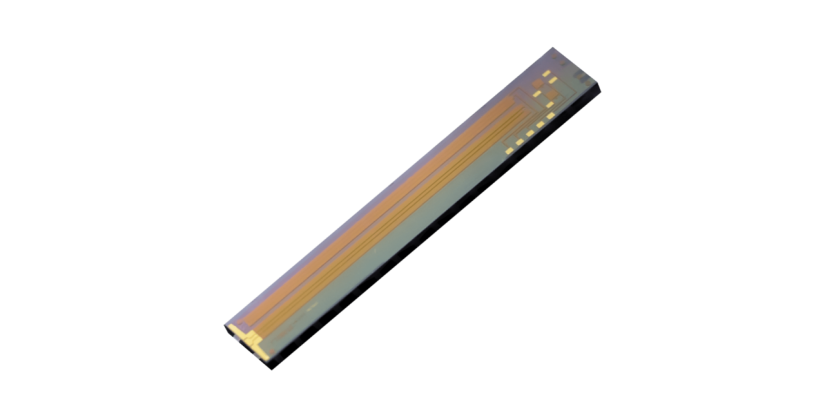
At Liobate, we recognize that the IDM (Integrated Device Manufacturer) model plays a pivotal role in advancing thin-film lithium niobate (TFLN) chip manufacturing. By integrating design, fabrication, and testing within our own facilities, Liobate technologies allow us to offer highly customized solutions for clients in high-speed optical communication and photonic integration. This integrated approach reduces the dependency on multiple external vendors, enabling faster project iterations, more precise alignment with customer specifications, and a more predictable development timeline. Our clients, ranging from data center operators to Lidar and quantum technology companies, benefit directly from this internal cohesion. For instance, our Intensity Modulator Die Chip achieves a 3dB-bandwidth of 110 GHz, ensuring high-speed data transmission with minimal latency, while maintaining a compact design suitable for complex photonic circuits.
Improving Performance and Reliability
Utilizing the IDM model provides us with direct control over all critical fabrication steps, which significantly enhances the performance and reliability of our TFLN devices. Our integrated workflow ensures consistent low insertion loss (<5 dB) and high extinction ratios (DC-ER > 20 dB), which are essential for modern high-speed optical networks and advanced communication systems. By combining proprietary design techniques with in-house manufacturing, Liobate technologies consistently deliver modulators with half-wave voltage below 3.0 V, supporting low-power operation while maintaining high-speed modulation. Additionally, by keeping design, fabrication, and testing under one roof, we reduce variability caused by supply chain handoffs, achieving reproducibility and stability that are crucial for large-scale deployment in AI optical networks and hyperscale data centers.
Enabling Innovation in Optical Systems
The IDM model also facilitates rapid innovation in optical systems by bridging R&D and manufacturing. At Liobate, we leverage this model to explore and implement new photonic architectures, optimized TFLN layouts, and high-speed electro-optic modulators. Our ability to iterate designs internally allows for quick testing of advanced features such as ultra-low loss waveguides and high-speed modulators, directly benefiting clients in Lidar, micro-wave photonics, and quantum communication applications. The Intensity Modulator Die Chip exemplifies our innovation efforts, providing a balance of speed, efficiency, and integration potential that is difficult to achieve when multiple external vendors are involved. This internal synergy enables us to respond rapidly to emerging customer needs, including requirements for ultra-high bandwidth chips and low-power operation in AI and 3.2T optical networks.
Conclusion: Strategic Advantage of IDM
In conclusion, adopting the IDM approach in TFLN chip manufacturing provides a strategic advantage by combining design flexibility, performance consistency, and innovation capability. Through Liobate technologies, we deliver solutions like our Intensity Modulator Die Chip, meeting demanding specifications with precise control over fabrication, testing, and quality assurance. This model allows us to respond swiftly to client needs, support high-speed optical communication systems, and advance photonic technologies in emerging sectors. By maintaining full in-house expertise and integrating design with production, Liobate ensures our partners receive reliable, high-performance photonic components tailored to their technical requirements. The IDM strategy underpins our commitment to providing cutting-edge, reproducible, and energy-efficient TFLN solutions for both established and emerging technology markets.


 The previous article
 Returns the list