Non-linear distortion is one of the most persistent challenges we face when deploying intensity modulator systems in analog or high-order digital communication links. Whether the application is RF-over-fiber, broadband signal distribution, or coherent optical transmission, any deviation from linear electro-optic response introduces intermodulation products, harmonic distortion, and degraded error vector magnitude. From our experience characterizing TFLN Devices, we have learned that while thin-film lithium niobate offers inherently high linearity, practical design choices—such as RF matching, bias control, and input power handling—often determine whether an intensity modulator achieves its theoretical performance. This article outlines proven strategies to identify and mitigate non-linear distortion before it compromises your link budget.
Understanding the Origins of RF-Induced Non-Linearity
At the material level, TFLN Devices exhibit a linear Pockels effect over a wide dynamic range. However, system-level non-linearity typically arises from three sources: overdriving the modulator beyond its linear swing, improper impedance matching causing signal reflections, and thermal drift shifting the operating point away from quadrature. For a typical intensity modulator with a half-wave voltage (Vπ) below 3.5 V, we must ensure that the RF drive amplitude stays below approximately 0.5×Vπ for analog links targeting high spurious-free dynamic range. Digital formats with higher order QAM are even more sensitive. Our rule: characterize the modulator’s transfer function empirically and set the RF gain so that peak-to-peak swing remains within the linear region—defined as the range where the slope variation is less than 5%.
Practical Techniques to Suppress Distortion
First, we implement active bias control. Even TFLN Devices with high stability can experience quadrature drift due to ambient temperature changes. A closed-loop dither scheme maintains the operating point at the most linear region (typically quadrature for analog, or null for digital pulse shaping). Second, we pay attention to RF return loss. An intensity modulator with 40 GHz bandwidth and 40% insertion loss specification (<6.5 dB) can still suffer from standing waves if the RF source and modulator are not impedance-matched. We use calibrated VNA measurements to verify return loss >10 dB across the operating band. Finally, we avoid saturating the photodiode after the modulator—a common but overlooked source of effective non-linearity.
Leveraging TFLN Advantages for Low-Distortion Links
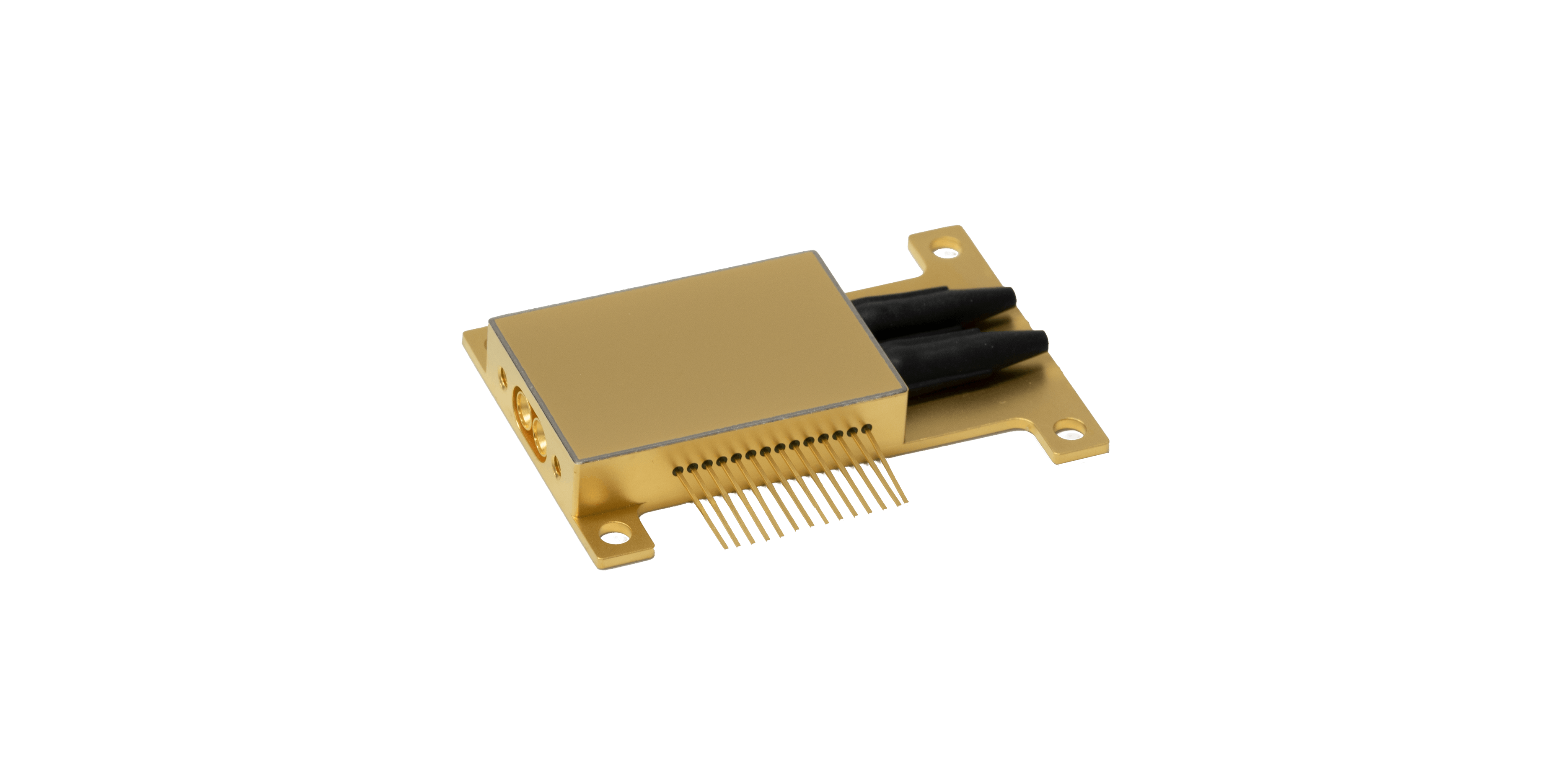
TFLN Devices offer a unique advantage: low Vπ (typically <3.5 V) combined with wide 3dB bandwidth (40 GHz for our IQ modulator). This allows us to drive the intensity modulator directly from moderate-power RF amplifiers, reducing the need for high-voltage gain stages that themselves introduce distortion. Moreover, the high stability and reliability of these Devices mean that bias-induced drift is minimal compared to other material platforms, simplifying long-term field deployment.
Achieving Linear Performance in Practice
Non-linear distortion in RF-driven intensity modulator systems is avoidable through careful gain staging, bias control, and impedance matching. By respecting the linear region of the transfer function and leveraging the inherent linearity of TFLN Devices, we can achieve high dynamic range for both analog and digital applications.
At Liobate, our TFLN Devices—including the 20/40 GHz IQ modulator with <6.5 dB insertion loss and <3.5 V Vπ—are designed to support demanding RF-over-fiber and broadband communication links. We recommend that your design team apply these mitigation techniques and consider our modulators for your next low-distortion photonic system.


 The previous article
 Returns the list