As the automotive industry pivots toward higher levels of autonomy, the limitations of traditional Time-of-Flight (ToF) LiDAR have become increasingly apparent. For true Level 4 and Level 5 autonomous driving, sensors must not only detect distance but also provide instantaneous velocity data while remaining immune to interference from sunlight or other vehicles. This shift has placed Frequency-Modulated Continuous-Wave (FMCW) LiDAR at the forefront of perception technology.
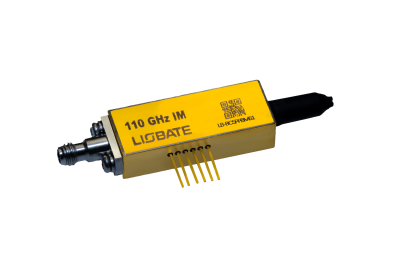
At Liobate, we understand that the performance of an FMCW system is fundamentally tied to the quality of its optical chirp. To achieve the necessary linearity and bandwidth for high-resolution imaging, the industry is rapidly transitioning toward TFLN Devices. In this technical evaluation, we will explore how the thin-film lithium niobate optical modulator serves as the critical enabler for next-generation LiDAR perception.
The Critical Role of Modulation in FMCW Architecture
Unlike ToF systems that measure the travel time of discrete laser pulses, FMCW LiDAR relies on a continuous laser beam that is frequency-modulated to create a "chirp." When the reflected signal returns, it is mixed with a local oscillator to produce a beat frequency that reveals both range and radial velocity (via the Doppler effect).
The precision of this "beat" depends entirely on the linearity and speed of the modulation. Any phase noise or non-linearity introduced during the chirping process results in "ghost" targets or reduced range resolution. This is why the selection of the modulator is the most significant architectural decision in FMCW design. Traditional silicon photonics often struggle with carrier-induced absorption and thermal instability, while legacy bulk lithium niobate is too bulky for automotive integration. Liobate's TFLN platform bridges this gap by providing high-speed, low-loss modulation in a compact, chip-scale form factor.
Key Metrics for Evaluating a Lithium Niobate Optical Modulator
When our B2B partners evaluate a lithium niobate optical modulator for LiDAR applications, we focus on four primary performance pillars: chirp linearity, power efficiency, bandwidth, and insertion loss.
1. Chirp Linearity and Phase Noise
In FMCW LiDAR, the range resolution is inversely proportional to the frequency sweep bandwidth. However, if the sweep is not perfectly linear, the resulting point cloud becomes blurred. Our TFLN Devices leverage the inherently linear Pockels effect of the lithium niobate crystal. Because TFLN does not rely on carrier injection (unlike silicon), it avoids the non-linear refractive index changes that plague other platforms, ensuring a pristine optical chirp.
2. Drive Voltage and Power Efficiency
Automotive sensors operate under strict power budgets. A significant advantage of the Liobate TFLN platform is the reduced gap between electrodes made possible by our sub-micron waveguide etching. This results in a remarkably low half-wave voltage (Vpi).
Liobate Specification: Our TFLN modulators typically achieve a Vpi of < 3.0 V, with some specialized designs reaching sub-1-volt levels. This allows the LiDAR system to be driven by standard CMOS-level electronics, eliminating the need for power-hungry high-voltage RF amplifiers.
3. Electro-Optical Bandwidth
To achieve centimeter-level range resolution, FMCW systems require wide frequency sweeps. While 40 GHz is a standard baseline, the next generation of long-range LiDAR demands even more.
Liobate Specification: We offer TFLN modulator chips with an EO bandwidth of 67 GHz and beyond, with flagship models reaching up to 110 GHz. This high bandwidth allows for faster chirps and higher frame rates in dense urban environments.
4. Insertion Loss and Signal Integrity
LiDAR systems are often photon-starved, especially when detecting low-reflectivity objects like dark clothing or asphalt at long distances. Every decibel of light lost within the modulator reduces the effective detection range.
Liobate Specification: Our TFLN intensity and phase modulators feature an ultra-low insertion loss of < 5 dB, ensuring that the maximum amount of laser power is projected onto the scene.
Enhancing Perception through Liobate TFLN Devices
The integration of TFLN technology into the LiDAR transceiver does more than just improve specs; it fundamentally changes the capability of the perception stack. By using a Liobate thin-film lithium niobate optical modulator, developers can implement multi-channel architectures (such as DR8 or PDM-IQ) that were previously too complex for a single chip.
Our TFLN PIC (Photonic Integrated Circuit) technology supports high-level integration of passive components—such as Bragg gratings and beam splitters—alongside high-speed modulators. This allows for the creation of 2D optical phased arrays (OPA) for solid-state beam steering, removing the need for mechanical spinning parts and significantly increasing the longevity and reliability of the sensor in automotive environments.
Overcoming Environmental Challenges in the Field
A common concern in B2B automotive applications is the "bias drift" associated with lithium niobate. In the past, temperature fluctuations in a vehicle could cause the modulator's operating point to shift, requiring constant recalibration.
We have addressed this head-on. Liobate has developed proprietary stabilization technologies that successfully eliminate the adverse effects of DC bias drift. Our resulting devices demonstrate highly stable and repeatable performance across a wide temperature range, which is critical for the rigorous AEC-Q100 standards required by the automotive industry. This stability ensures that the LiDAR perception remains accurate from the moment the vehicle starts in a cold climate to long-duration operation in high-heat environments.
Conclusion: Driving the Future of LiDAR with Liobate
The transition to FMCW LiDAR is a necessary step for the future of autonomous mobility, but its success depends on the underlying photonic components. Evaluating the performance of a lithium niobate optical modulator is no longer just about checking a bandwidth box; it is about ensuring the system can deliver reliable, high-resolution 4D data in real-world conditions.
By choosing Liobate as a partner, B2B organizations gain access to a suite of TFLN Devices designed specifically for the rigors of high-speed communication and sensing. Our commitment to low driving voltages, high bandwidth, and thermal stability makes our TFLN platform the ideal choice for developers looking to push the boundaries of what LiDAR perception can achieve. As we continue to refine our PIC technology, we look forward to powering the sensors that will make autonomous transport a safe and efficient reality for everyone.


 The previous article
 Returns the list