The global demand for data is accelerating at an exponential rate, driven by the proliferation of artificial intelligence, cloud computing, and 5G/6G infrastructures. As we look toward the next horizon in optical communications, the industry is setting its sights on the 3.2T transceiver—a massive leap that represents a fourfold increase in capacity over current 800G standards. At Liobate, we believe that achieving this milestone requires more than just incremental improvements; it demands a fundamental shift in materials and device architecture. By harnessing the unique properties of TFLN Devices, we are building the foundation for the Terabit era, ensuring that the IQ modulator remains the high-speed engine of the modern optical network.
The Scaling Challenges of Next-Generation Transceivers
Scaling to 3.2T presents a significant engineering challenge: how to increase data throughput while maintaining a manageable power budget and physical footprint. Currently, the industry relies on increasing the baud rate and utilizing higher-order modulation formats like 64-QAM or 128-QAM. However, as symbol rates push toward 200 Gbaud and beyond, traditional modulation platforms begin to encounter physical limitations. Silicon photonics and bulk lithium niobate often struggle with bandwidth-voltage tradeoffs that make 3.2T scaling economically and technically difficult.
At Liobate, we address these challenges through the integration of Thin Film Lithium Niobate. Unlike legacy materials, TFLN allows us to create waveguides with extremely high confinement and low loss. This architecture enables us to drive the IQ modulator at much higher frequencies with lower power consumption. For B2B clients developing the next generation of pluggable modules (such as OSFP-1600 or the future 3.2T form factors), this efficiency is not just a benefit—it is a requirement for survival in a power-constrained data center environment.
Breaking the Bandwidth Barrier with TFLN Devices
To reach 3.2T, the optical components must support ultra-wide electro-optic (EO) bandwidths. We are currently seeing a shift where the required bandwidth for 200 Gbaud systems exceeds 100 GHz. Traditional modulators often suffer from significant roll-off at these frequencies, which degrades the signal-to-noise ratio and limits the reach of the fiber link. Our research and development at Liobate has successfully demonstrated TFLN-based modulators that maintain a flat frequency response well into the sub-millimeter wave regime.
By utilizing TFLN Devices, we can achieve a near-perfect velocity match between the RF signals and the optical waves. This velocity matching is the "secret sauce" that allows our IQ modulators to operate at ultra-high speeds without the signal distortion typically found in thicker, bulkier crystals. Furthermore, the low dielectric constant of the thin-film substrate reduces RF loss, ensuring that the drive signal reaches the modulation region with maximum integrity. This technical edge is why we believe TFLN is the only viable platform for the 3.2T roadmap.
Energy Efficiency: The "Watts per Terabit" Metric
As we move toward higher capacities, the energy efficiency of the modulation stage becomes a critical metric for B2B system designers. In a 3.2T system, every milliwatt of power saved at the modulator level translates to significant savings in cooling and power distribution costs at the rack level. One of the primary advantages of our TFLN platform is the dramatic reduction in half-wave voltage. While legacy modulators might require 5V or more, our TFLN-based IQ modulator solutions typically operate at 100GHz.
Lowering the drive voltage allows for the use of more efficient, low-power CMOS or SiGe drivers, eliminating the need for high-power, high-cost RF amplifiers. At Liobate, we are committed to lowering the "Watts per Terabit" ratio for our partners. By providing modulators that are easier to drive, we enable our clients to design denser, cooler, and more reliable networking equipment. This focus on green photonics is central to our corporate strategy as we help build a more sustainable global communication infrastructure.
Integration and the Rise of Photonic Integrated Circuits (PICs)
The path to 3.2T is not just about speed; it is about density. A 3.2T transceiver will likely require the parallel integration of multiple IQ modulators and high-speed detectors onto a single Photonic Integrated Circuit (PIC). The small footprint of our TFLN Devices makes them ideal for this level of integration. Because the waveguides can be bent at much tighter radii than bulk crystals, we can significantly reduce the overall size of the modulation array.
At Liobate, we operate as a full-service IDM, allowing us to offer highly integrated solutions to our B2B partners. We are not just providing standalone modulators; we are developing integrated "engine" chips that combine multiple modulation channels with splitters, combiners, and monitoring photodiodes. This integrated approach reduces the complexity of the optical assembly, improves phase stability across channels, and lowers the cost per bit. For companies aiming to be first-to-market with a 3.2T solution, our integrated TFLN platform provides a decisive advantage in both performance and time-to-market.
Technical Specifications for the 3.2T Era
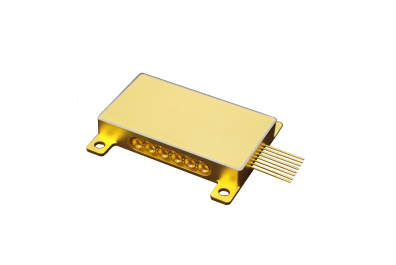
Liobate’s current TFLN IQ modulators are designed with the future in mind. Our devices feature an electro-optic bandwidth (3dB) of over 110 GHz and an ultra-low insertion loss typically under 5 dB. These components are optimized for the C-band, with high extinction ratios (typically >25 dB) that ensure clean constellations even for complex 128-QAM signals. The packaging is designed for high-frequency reliability, utilizing GPO or specialized high-speed RF interfaces to ensure seamless connectivity with the latest generations of DSPs.
Furthermore, we offer these devices with a high degree of customization to meet the specific needs of B2B system architects. Whether it is a specific pigtail length, a custom RF layout, or a specific thermal management requirement, we work closely with our clients to ensure the IQ modulator is perfectly matched to their 3.2T transceiver design. This collaborative engineering process is a hallmark of Liobate’s commitment to technical excellence.
Conclusion: Leading the Terabit Revolution
The transition to 3.2T represents one of the most significant challenges the optical networking industry has ever faced. It requires a convergence of high-speed electronics, advanced digital signal processing, and, most importantly, high-performance integrated photonics. At Liobate, we are proud to be leading the charge with our TFLN Devices. By solving the bandwidth and power consumption hurdles of the past, we are paving a clear path for the Terabit future.
As we continue to push the boundaries of Thin Film Lithium Niobate technology, our focus remains on providing the B2B community with the most reliable and innovative IQ modulator solutions on the market. We believe that the 3.2T era will be defined by those who can harness the power of integrated photonics to move more data, more efficiently, and more reliably. We invite you to partner with Liobate as we continue to innovate and pave the way for a faster, more connected world.


 The previous article
 Returns the list