The autonomous vehicle industry and the broader field of industrial robotics are currently standing at a technological crossroads. For years, Time-of-Flight (ToF) LiDAR has been the standard for spatial mapping, but as we move toward Level 3 and Level 4 autonomy, the limitations of ToF—specifically its susceptibility to environmental interference and inability to measure instantaneous velocity—have become apparent. We are now seeing a decisive shift toward Frequency-Modulated Continuous Wave (FMCW) LiDAR. At Liobate, we believe that the success of this transition depends entirely on the evolution of integrated photonic chips.
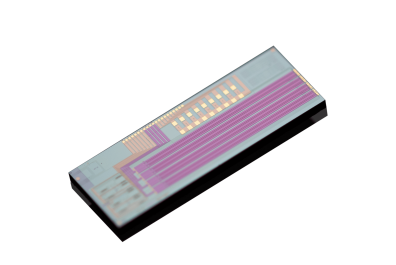
FMCW LiDAR represents a leap in sensing sophistication, offering high sensitivity and "4D" sensing (3D position plus velocity). However, the complexity of managing coherent light signals requires a level of precision that discrete components cannot provide. By leveraging our specialized tfln chips, we are enabling a new generation of LiDAR systems that are smaller, more reliable, and significantly more capable than their predecessors.
Why FMCW Demands Integrated Photonic Chips
To understand why integration is mandatory for FMCW, we must look at the underlying physics. Unlike ToF, which measures the "bounce back" time of a light pulse, FMCW relies on the interference between a transmitted frequency-swept laser and the reflected signal. This requires an incredibly stable local oscillator and high-speed, linear modulation to create the frequency "chirp."
In a discrete system, the laser, the frequency modulator, and the balanced photodetector are separate entities connected by fiber. Any vibration or thermal fluctuation in these connections introduces phase noise, which degrades the accuracy of the range and velocity data. By moving to integrated photonic chips, we eliminate these external variables. At Liobate, we integrate these critical functions onto a single Thin-Film Lithium Niobate (TFLN) substrate. This monolithic approach ensures that the optical path remains stable, allowing for centimeter-level ranging precision at distances exceeding 300 meters.
The TFLN Advantage in Sensing Architecture
When we discuss the "autopilot" and "sensing" sectors, the material platform chosen for the Photonic Integrated Circuit (PIC) is the most critical decision. While silicon photonics is a popular choice, it often struggles with high insertion loss and limited modulation linearity. This is where our tfln chips provide a distinct B2B advantage.
Lithium Niobate is naturally gifted with a strong electro-optic effect and high linearity. When processed into a thin film, these properties are amplified. Our sensing-optimized chips offer:
Ultra-High Linearity: FMCW requires a perfectly linear frequency sweep (the "chirp") to avoid ghosting or measurement errors. Our TFLN modulators provide the high linearity necessary to maintain a constant chirp slope across a wide frequency range.
Low Driving Voltage: Power consumption is a major concern for automotive OEMs. Our integrated photonic chips achieve a half-wave voltage as low as 1.5V to 2V, significantly reducing the power burden on the LiDAR’s electronic control unit (ECU).
High Bandwidth for Precision: Our 40 GHz and 70 GHz modulators allow for ultra-fast modulation, which directly translates to higher resolution in the frequency domain. This enables the LiDAR to distinguish between objects that are only centimeters apart, even at high speeds.
Structural Reliability for Harsh Environments
In the B2B market, specifically for automotive and industrial sensing, performance is secondary to reliability. A LiDAR system must operate flawlessly in the presence of engine vibrations, extreme temperatures, and electromagnetic interference. Discrete optoelectronics, with their multiple points of failure and delicate fiber alignments, are often the "weakest link" in an autonomous sensor suite.
We have designed our tfln chips to address these environmental challenges head-on. By utilizing wafer-level bonding and proprietary hermetic packaging, we ensure that the optical circuit is shielded from the elements. Furthermore, the inherent stability of the lithium niobate crystal means that our modulators do not suffer from the "bias drift" that complicates silicon-based designs. For our partners, this means a "set-and-forget" solution that maintains its calibration over the entire lifespan of the vehicle.
Scaling FMCW with Optical Phased Arrays (OPA)
Beyond the modulator, the next frontier in sensing is solid-state beam steering. Traditional LiDARs rely on spinning mirrors, which are prone to mechanical wear. We are currently exploring the integration of Optical Phased Arrays (OPA) onto our integrated photonic chips.
By using an array of phase shifters on a TFLN platform, we can steer the laser beam electronically. This transition from mechanical to solid-state steering is a game-changer for the B2B sector. It allows for a "no-moving-parts" LiDAR that can be seamlessly integrated into the bumper or behind the windshield of a car. Because Liobate technology supports high-density integration, we can pack hundreds of these phase-shifting elements into a footprint smaller than a fingernail, providing the high angular resolution required for highway-speed navigation.
Enhancing Eye Safety and SNR
A final, often overlooked benefit of our integrated approach is the improvement in the Signal-to-Noise Ratio (SNR). Because our tfln chips exhibit exceptionally low insertion loss (often <5 dB for the modulator die), more of the laser's energy reaches the target and returns to the detector.
This efficiency allows FMCW systems to operate at lower peak power levels than ToF systems while achieving the same range. Operating at 1550nm—a wavelength handled superbly by TFLN—ensures that the LiDAR is eye-safe. This is a critical regulatory requirement for B2B vendors selling into the consumer automotive market. High efficiency means the system can detect low-reflectivity objects, such as dark clothing or tires, at long distances, providing the critical "buffer time" needed for autonomous braking systems to react.
Conclusion
The evolution of autonomous sensing is no longer a question of "if," but "how." As the industry moves toward the superior accuracy of FMCW, the role of integrated photonic chips becomes the defining factor in market success. At Liobate, we are proud to provide the tfln chips that serve as the heartbeat of these advanced sensors.
By combining world-class electro-optic performance with the reliability of a solid-state integrated platform, we are helping our B2B partners transition from prototypes to mass-market autonomous solutions. The terabit era of communication has met the high-definition era of sensing, and together, we are building a safer, more precise future.


 The previous article
 Returns the list