Dissipative Kerr soliton (DKS) optical frequency combs have rapidly become a cornerstone technology for high-speed optical communications and precision metrology. At Liobate, we specialize in the design and manufacture of advanced TFLN Devices that enable robust, low-loss comb generation. Our expertise in thin-film lithium niobate ensures that these devices meet the stringent demands of next-generation photonic systems. By integrating high-performance modulators and compact chip designs, we provide solutions that cater to both industrial and research applications, bridging the gap between laboratory innovation and scalable production.
Understanding Dissipative Kerr Solitons
A Dissipative Kerr Soliton optical frequency comb arises from a balance between nonlinearity and dispersion in microresonator systems. These solitons generate highly stable, evenly spaced spectral lines, making them ideal for applications such as coherent communications, Lidar, and quantum technologies. In our work at Liobate, we leverage proprietary TFLN Devices to enhance modulation speed and minimize insertion loss. Our chips offer ultra-low half-wave voltage, high RF bandwidth, and compact footprint, allowing engineers to integrate frequency combs into diverse optical systems without compromising performance or reliability.
Features of Our Optical Frequency Comb Solutions
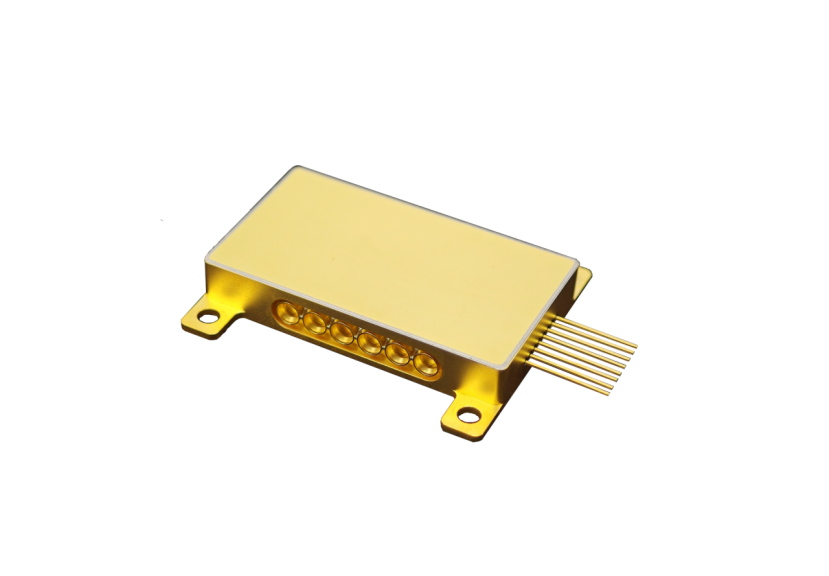
Our Optical Frequency Comb solutions include both 1-level and customizable 3-level configurations. The 1-level comb features a 25 GHz RF bandwidth, half-wave voltage below 2.5 V, insertion loss less than 9 dB, and a high integration factor, resulting in a compact and efficient design. For more advanced requirements, our 3-level optical frequency comb can be tailored to specific spectral spacing and output power, providing flexibility for complex photonic systems. By offering both high performance and scalability, Liobate ensures that customers can implement cutting-edge frequency comb technologies in communications, sensing, and emerging AI-driven photonics.
Integration and Applications
The high integration and low-power characteristics of our TFLN Devices make them particularly suitable for data centers, AI optical networks, and Lidar systems. By combining ultra-fast modulation with minimal optical loss, our Liobate chips support advanced applications such as 400G, 800G, and even 1.6T optical links. Additionally, these devices facilitate research in quantum photonics and microwave photonics, enabling universities and R&D labs to explore novel experimental configurations. Our team provides end-to-end support, from design consultation to custom device fabrication, ensuring seamless adoption of optical frequency comb solutions.
Conclusion: Advancing Photonics with Liobate
In conclusion, Liobate offers a comprehensive range of TFLN Devices and optical frequency comb solutions that combine compact design, high integration, and customizable performance. Our commitment to innovation in thin-film lithium niobate technology allows us to provide clients with devices that are not only efficient but also scalable for industrial deployment. Whether for high-speed communications, Lidar sensing, or advanced photonics research, our optical frequency comb platforms deliver stable, precise, and versatile operation. We continue to push the boundaries of soliton-based frequency combs, supporting the next generation of optical systems with proven expertise and flexible solutions.


 The previous article
 Returns the list